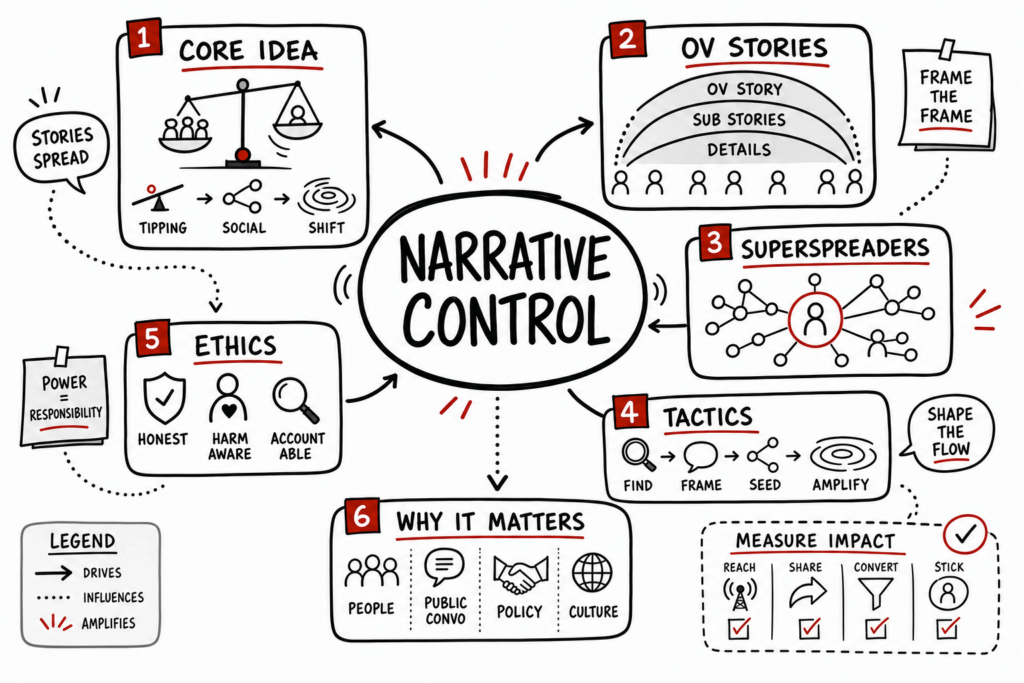
What is the Revenge of the Tipping Point summary for leaders?
Revenge of the Tipping Point summary: Malcolm Gladwell’s new book is a useful briefing for founders, executives, and influence-driven professionals on how social epidemics can be shaped, amplified, and sometimes manipulated. The strategic implication is clear: leaders should stop treating virality, culture, and reputation as accidents and start asking who controls the conditions around them. Gladwell updates the original tipping point model with ideas such as overstories, which you can define as dominant narratives that quietly set the rules for how groups behave. For business readers, the practical KPI is not simply reach; it is narrative conversion—how many people adopt the same explanation, behavior, or status signal after exposure. If you care about business influence and social contagion, this book belongs on your list, but it works best as a provocation, not a complete operating manual.
Book Overview: The Tipping Point Sequel Summary
Revenge of the Tipping Point is Malcolm Gladwell returning to the territory that made him unavoidable in leadership circles: how small forces create outsized social change. Published by Little, Brown and Company, the book is positioned as the long-awaited sequel to The Tipping Point, but the mood is different. The original book felt curious, optimistic, and fascinated by how trends spread. This one is more suspicious. It asks what happens when the mechanics of contagion are not merely observed but deliberately engineered.
That shift matters for executives. In 2000, many leaders read Gladwell to understand word-of-mouth, connectors, mavens, and social epidemics. In 2024, the more urgent question is not whether ideas spread. It is who designs the environment that makes one idea feel inevitable while another dies quietly. That makes this Malcolm Gladwell new book summary especially relevant for founders, brand leaders, real estate executives, political operators, and anyone responsible for trust at scale.
You can view the official publisher listing for Revenge of the Tipping Point at Little, Brown, and readers who want more context on Gladwell’s broader body of work can also reference Gladwell’s official books site.
Who Should Read It
This is a strong fit if you are responsible for shaping perception before the market fully understands what is happening. Founders launching category-defining companies, executives managing reputation risk, luxury real estate leaders building market authority, and operators trying to understand why some stories harden into consensus will get value here.
It is also a useful book review for executives because Gladwell does not write like a consultant selling a framework. He writes like a narrative investigator. That is both the strength and the limitation. You will not get a step-by-step playbook for demand generation or culture change. You will get a sharper instinct for spotting the invisible architecture behind behavior.
So, should I read Revenge of the Tipping Point? Yes, if you are already thinking about influence, incentives, network effects, social proof, institutional trust, or how markets decide what to believe. Skip it if you need a tactical handbook with dashboards, templates, and implementation timelines.
Core Idea: Overstories, Superspreaders, and Engineered Reality
The core idea is that social contagion is no longer something leaders can afford to describe passively. Gladwell’s updated lens suggests that ideas, behaviors, and reputations move through populations because certain people, places, and narratives create unusually favorable conditions for spread.
The two concepts business readers should pay attention to are superspreaders and overstories. Superspreaders are not just people with large audiences. In business terms, they are nodes with disproportionate influence over adoption. That could be a respected broker in a luxury market, a CFO whose software preferences ripple across a peer group, a neighborhood tastemaker, or a media figure whose framing becomes the default.
Gladwell overstories explained in practical language: an overstory is the dominant narrative canopy above a group. It shapes what people notice, what they ignore, what they reward, and what they punish. In a company, the overstory might be “we are the premium operator” or “speed matters more than polish.” In a market, it might be “this neighborhood is the next wealth corridor” or “this founder is inevitable.” Once an overstory takes hold, individual decisions start looking independent while actually moving in the same direction.
Best Takeaways: Revenge of the Tipping Point Key Takeaways
1. Influence is environmental, not just personal
One of the strongest Revenge of the Tipping Point key takeaways is that persuasion is rarely just about the message. It is about the setting around the message. The same offer, brand, or idea can fail in one environment and spread rapidly in another because the surrounding story has changed.
For leaders, this means your influence strategy should not start with “How do we get more attention?” It should start with “What conditions would make our idea feel obvious?” That question is more strategic and less expensive than chasing every platform trend.
2. Narrative control is a leadership function
The book is especially useful on the uncomfortable reality that narratives do not merely describe markets; they help create them. A luxury development, a founder reputation, a company culture, or a professional service brand can all become more valuable when the right people repeat the right explanation often enough.
This is one of the clearest Revenge of the Tipping Point leadership lessons: if you do not define the overstory, someone else will. Employees will invent one. Competitors will exploit one. The market will simplify you into one. Leaders who treat storytelling as soft work usually discover too late that story has become strategy.
3. Virality without ethics becomes manipulation
Gladwell is not writing a celebratory manual for going viral. The book carries a more cautionary tone. For executives, that is important. Social engineering can be commercially powerful and reputationally dangerous. If your growth depends on confusion, fear, false scarcity, or status anxiety, the short-term lift can become a long-term liability.
The smarter application is to use contagion principles to make true things travel faster: superior service, credible expertise, operational excellence, client success, and community trust.
Revenge of the Tipping Point Strategy Lessons for Business
The most useful Revenge of the Tipping Point strategy lessons are not about copying Gladwell’s examples. They are about changing the diagnostic questions you ask inside the business.
First, identify your superspreaders. In a B2B context, that may mean the 20 clients, advisors, analysts, investors, or operators who influence 80 percent of serious perception in your category. In luxury real estate, it may be the small circle of agents, wealth managers, attorneys, designers, and past clients who quietly validate the market’s confidence in you.
Second, audit your current overstory. Ask five serious people what your company is known for. If the answers are inconsistent, you do not have a controlled narrative. If the answers are accurate but uninspiring, you may have operational credibility without market magnetism. If the answers are flattering but false, you have a reputation risk waiting to mature.
Third, measure narrative conversion. This is not a standard KPI, but it should be. Track whether prospects, clients, partners, and media repeat your preferred language without prompting. If your market starts using your words to describe the problem, you are no longer just marketing. You are shaping the category conversation.
Where It Falls Short
This Revenge of the Tipping Point review would be incomplete without saying where the book may frustrate high-performance readers. Gladwell is brilliant at assembling stories that make a pattern feel vivid. He is less interested in giving you a clean implementation system. If you want a spreadsheet-ready model for influence, you will need to build it yourself.
The second limitation is familiar to Gladwell readers: the narrative can sometimes feel stronger than the proof architecture. He is not careless, but he is a storyteller first. The risk is that readers walk away with memorable concepts and underestimate the messy operational work required to use them responsibly.
The third caveat is that leaders may over-apply the book. Not every behavior is a contagion problem. Not every market shift comes from a hidden overstory. Sometimes pricing is wrong. Sometimes the product is weak. Sometimes the sales team is undertrained. Gladwell’s lens is powerful, but it should not become your only lens.
How to Apply It
Run a superspreader map
List the 50 people or institutions with the highest credibility in your target market. Score each one from 1 to 5 on trust, reach, relevance, and willingness to engage. Your best influence targets are not always the biggest names. They are the people whose endorsement changes the behavior of serious buyers.
Define the overstory you want to own
Write one sentence that explains the market belief you want to make more common. For example: “The next generation of luxury clients values discretion, data, and access over public visibility.” Then test whether your content, client experience, partnerships, and executive presence all reinforce that belief.
Separate attention from adoption
A post can reach 100,000 people and change nothing. A private briefing can reach 12 decision-makers and alter a market. Use Gladwell’s thinking to focus less on volume and more on behavioral movement. Did the right people repeat the idea? Did they act differently? Did they introduce you to others with the same framing?
Build ethical contagion into operations
Do not use the book as permission to manipulate. Use it as a reminder that trust spreads when the experience deserves repetition. The strongest business influence still comes from a clean alignment between story, proof, and delivery.
Final Verdict
Revenge of the Tipping Point is worth reading if you want a sharper understanding of how modern influence works. It is not a tactical growth manual, and it should not be treated as one. Its value is in helping leaders see the architecture behind momentum: the people who accelerate belief, the narratives that make behavior feel natural, and the conditions that turn isolated actions into social patterns.
For ambitious professionals, the best use of the book is simple: read it, extract the questions, and apply them to your market before your competitors do. The original Tipping Point helped leaders think about how ideas spread. This sequel asks a harder question: who benefits when they do?
If you want more private-briefing style strategy reads for executives, founders, and luxury market leaders, explore more RE Luxe Leaders book reviews—or book a confidential strategy call to translate these ideas into your positioning, influence, and growth plan.