
Traction Gino Wickman Summary: Eos for Real Estate Teams
What Is the Best Traction Gino Wickman Summary for Leaders?
A Traction Gino Wickman summary is most useful for founders, team leaders, and real estate operators who need a practical read on the Entrepreneurial Operating System and whether it can turn a busy service business into a more accountable company. In Traction, Gino Wickman argues that growth stalls when vision, people, data, issues, process, and execution are handled informally. EOS defines an operating system as a repeatable way to set priorities, run meetings, assign ownership, and measure progress; examples include 90-day Rocks, a weekly Scorecard with 5 to 15 leading indicators, and Level 10 Meetings. The strategic implication is simple: if your team has revenue momentum but inconsistent follow-through, Traction is worth reading. If you already have disciplined dashboards, documented processes, and clear seats, it may feel basic—but still useful as a common language.
Book Context and Author Background
Traction was published in 2011, but it still circulates heavily in founder rooms because it addresses a problem that has not aged out: companies outgrow charisma before they outgrow opportunity. Gino Wickman built the EOS model after working with entrepreneurial leadership teams that had talent, revenue, and ambition, but lacked consistent operating discipline.
This Traction book review is not about whether EOS is fashionable. It is about whether the book gives a practical leader enough structure to reduce chaos. The answer is yes, with caveats. Wickman is not trying to write a theory of leadership. He is offering a field manual for owners who are tired of repeating themselves, tolerating fuzzy accountability, and watching priorities shift every week.
For broader context, the official EOS overview defines the system as a complete set of simple concepts and practical tools for running a business. That positioning matters. EOS is not a brand strategy, a sales methodology, or a culture transformation program by itself. It is a management cadence. Used properly, it gives a growing company a shared operating language.
Core Idea
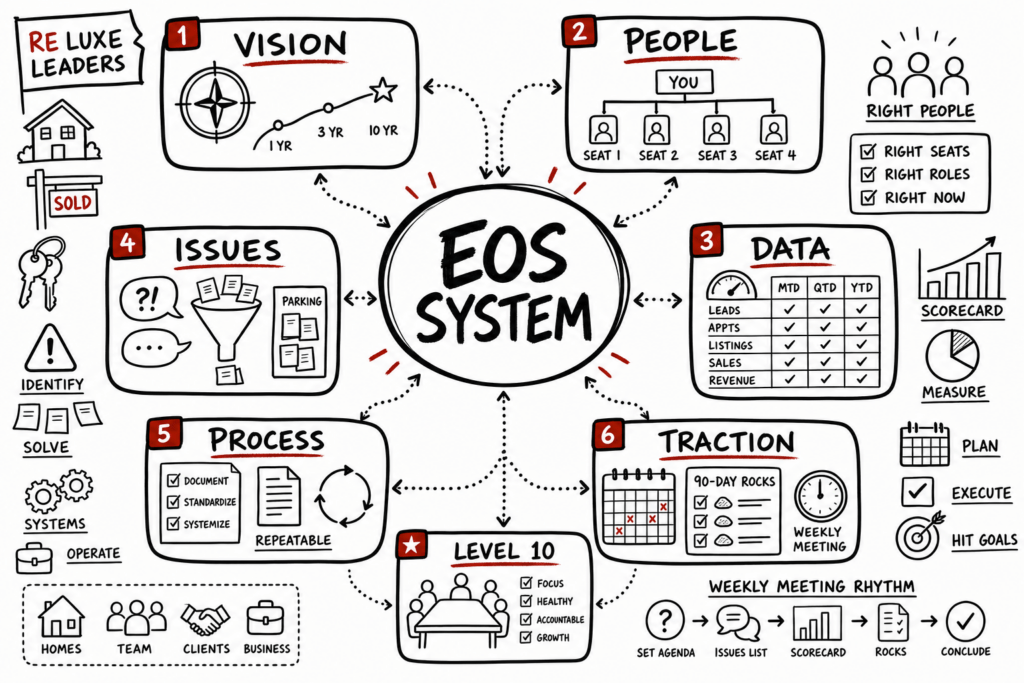
The core idea of the Gino Wickman EOS framework is that most entrepreneurial companies are not failing because they lack ideas. They are failing because the leadership team has not translated ideas into a clear operating system. Wickman organizes the company around six key components: Vision, People, Data, Issues, Process, and Traction.
That structure is the heart of any useful Entrepreneurial Operating System summary. Vision means everyone knows where the business is going and how it intends to get there. People means the company has the right people in the right seats. Data means leaders stop managing only by gut feel. Issues means problems are surfaced and solved instead of discussed endlessly. Process means the core way of doing business is documented and followed. Traction means the company executes through quarterly priorities and weekly accountability.
The book’s strongest move is its insistence that complexity is often a leadership avoidance mechanism. Many teams create long plans, crowded dashboards, and vague committees because they do not want to make crisp choices. EOS pushes the opposite direction: fewer priorities, clearer owners, tighter meeting rhythm, and more honest conversations.
Who Should Read It
Traction is best for founders, operators, managing brokers, rainmakers, and leadership teams running companies that have moved past the scrappy stage but have not yet professionalized. If your business depends on a few heroic people remembering everything, this book will feel uncomfortably relevant.
It is especially useful for Traction for real estate teams. Real estate organizations often grow through sales talent first and operational design second. A high-producing brokerage team may have lead sources, agents, transaction coordination, client care, listing operations, recruiting, marketing, and vendor management all moving at once. Without a clear operating rhythm, the leader becomes the router for every decision.
EOS gives that leader a way to separate roles, define priorities, measure weekly activity, and reduce the emotional noise around accountability. It will not make weak agents productive or fix a broken value proposition. But it can expose where the business is relying on personality instead of structure.
This is also a solid read for executives in service businesses, agencies, advisory firms, and local market operators who need a business operating system for teams. If your company is large enough to need managers but small enough that the founder is still pulled into everything, the book meets you where you are.
Best Takeaways
1. Accountability needs a seat, not a speech
One of the sharpest Traction key takeaways is that accountability becomes real when every major function has an owner. Wickman’s accountability chart is not just an org chart with nicer language. It asks: what work must be owned for this company to run well, and who is truly accountable for each seat?
For a real estate team, that might mean separating sales leadership, listing operations, buyer experience, recruiting, marketing, client events, finance, and transaction coordination. The question is not whether one person currently does several jobs. The question is whether the work is named clearly enough to scale beyond improvisation.
2. Quarterly priorities beat annual wish lists
The book’s emphasis on 90-day Rocks is practical. Annual goals sound impressive, but many teams lose focus by February. Quarterly priorities force leadership to define what matters now. For example, instead of saying, “Improve lead conversion,” a team might set a 90-day Rock to implement a lead response standard, audit 100 recent leads, and raise speed-to-lead compliance to a defined threshold.
3. Meetings are not the enemy; bad meetings are
The Level 10 Meeting concept is one of the most cited leadership lessons from Traction. Wickman argues that leadership teams need a consistent weekly forum to review numbers, check priorities, identify issues, and solve what matters. The useful shift is moving from status theater to decision discipline.
In practice, this means fewer scattered conversations during the week and more structured issue processing. For ambitious professionals, that is not bureaucracy. It is attention management.
4. Data should reduce drama
EOS pushes companies to build a Scorecard of leading indicators. This is particularly relevant in real estate, where leaders often overreact to closed volume because it is a lagging metric. Better weekly indicators might include new appointments set, listing consultations held, signed agreements, active pipeline value, lead response time, database conversations, and pending transaction risk flags.
The point is not to worship numbers. The point is to stop discovering problems after they have already become expensive.
Where It Falls Short
This EOS book review would be incomplete without saying what is overhyped. Traction can make EOS feel cleaner than implementation usually is. The tools are simple. The human work is not. Leaders still have to make difficult calls about underperformance, compensation, decision rights, and whether trusted long-term people are actually right for the next stage of the business.
The book also underplays how much context matters. A luxury real estate team, a property management firm, and a fast-scaling software company may all use EOS, but their scorecards, meeting rhythms, and process depth should not look identical. Copying the format without adapting the operating logic creates performative structure.
Another limitation: EOS is not a substitute for strategy. This is one of the most important strategy lessons from Traction. The system helps a team execute what it chooses. It does not automatically determine whether the chosen market position is strong, whether the offer is differentiated, or whether the growth model is financially sound. If the strategy is weak, EOS can simply help you pursue the wrong plan more efficiently.
Finally, the tone of the book is intentionally simple. Some sophisticated operators may find the language repetitive. That does not make it useless. It means the value is in adoption, not novelty.
How to Apply It
If you are considering EOS for a real estate or service business, do not start by announcing a sweeping operating system rollout. Start with a diagnostic.
Step 1: Identify the current bottleneck
Ask where the business is actually leaking energy. Is the issue unclear priorities, weak management, inconsistent follow-up, undocumented processes, poor recruiting, or lack of financial visibility? EOS works best when attached to a real operational pain, not a vague desire to “get organized.”
Step 2: Build a simple accountability chart
List the functions the company needs over the next 12 to 24 months, not just the people currently on payroll. For a real estate team, include lead generation, conversion, client experience, listings, buyer-side operations, transaction management, finance, database, recruiting, and leadership. Then assign one accountable owner per seat where possible.
Step 3: Choose five to fifteen weekly numbers
Use the Scorecard idea carefully. Do not track everything because you can. Track the few indicators that predict future performance. A team selling high-end homes might monitor qualified conversations, private showings, listing appointments, signed listing agreements, price improvement conversations, offer activity, and pending deal risk.
Step 4: Set three to seven quarterly Rocks
If everything is a priority, nothing is. Pick the projects that would materially improve the business in the next 90 days. Examples: document the listing launch process, implement a client review cadence, rebuild the referral database workflow, hire an operations manager, or reduce contract-to-close errors by a measurable amount.
Step 5: Run one disciplined weekly leadership meeting
Use a consistent agenda. Review numbers. Check Rocks. Surface issues. Solve the highest-value problems. Capture next actions. The official EOS tools library is a useful reference if you want templates, but the discipline matters more than the document.
Is Traction Worth Reading?
Yes, is Traction worth reading is easy to answer for teams that have ambition but inconsistent execution. Read it if your company is growing, but the founder is still the memory, referee, and emergency brake. Read it if your leadership meetings produce conversation but not closure. Read it if your team confuses being busy with being aligned.
Skip or skim it if you already have a mature operating cadence, clean KPIs, strong managers, and a documented execution system your team actually uses. Even then, Traction may still be useful as a shared vocabulary for simplifying how you run the business.
The private briefing version: Traction is not magic. It is a practical operating discipline for companies that need to grow up without becoming corporate. For real estate teams, its value is in replacing founder dependency with clearer seats, sharper priorities, and a weekly rhythm that makes avoidance harder.
For more strategy briefings built for ambitious real estate leaders, read the latest RE Luxe Leaders reviews—or book a confidential strategy call when you are ready to tighten the operating system behind your growth.