
Smart Growth Whitney Johnson Summary for Scaling Teams
What is the Smart Growth Whitney Johnson summary?
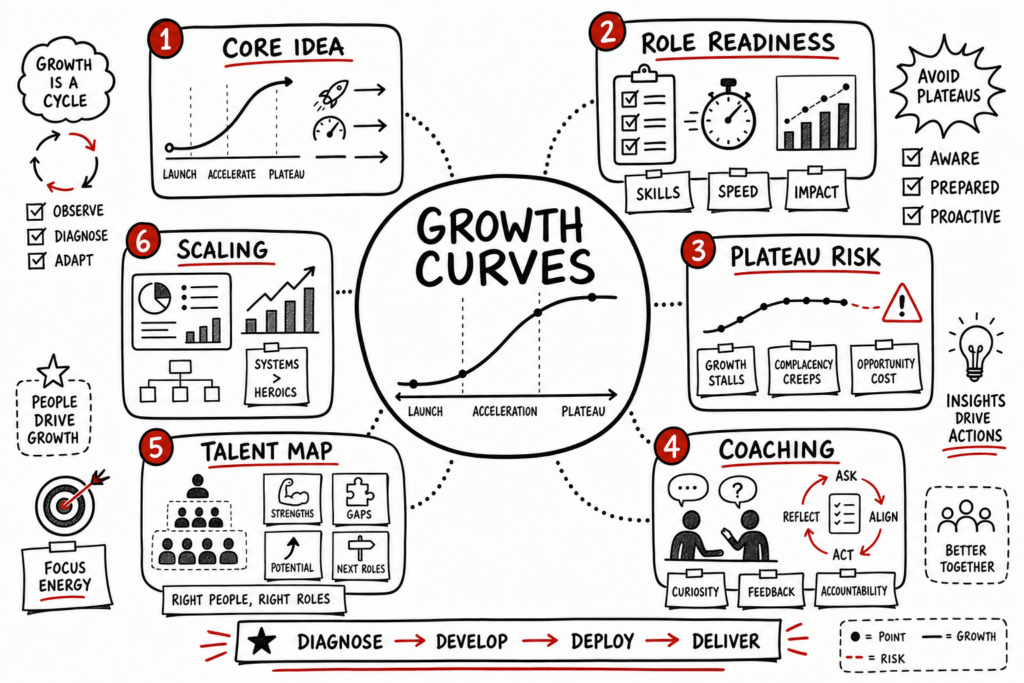
This Smart Growth Whitney Johnson summary is for ambitious real estate firm owners, team leaders, and operators who need a clearer talent-development system, not another motivational growth book. In Smart Growth, Whitney Johnson argues that people and companies grow best by moving through an S-curve: slow early learning, rapid acceleration, and eventual mastery or plateau. The strategic implication is simple: if your team’s growth is unmanaged, your company’s growth will eventually stall. A practical KPI is role-readiness velocity: how many months it takes a hire or manager to move from dependent execution to reliable independent performance. For scaling brokerages, advisory teams, and luxury real estate groups, the book is most useful as a diagnostic for talent bottlenecks, manager coaching cadence, succession planning, and keeping high performers challenged before they disengage.
Book Positioning and Audience Fit
Smart Growth by Whitney Johnson sits in the leadership-development lane, but its strongest use is operational. This is not a book about vague personal transformation. It is a framework for understanding how capability develops, why people stall, and what leaders can do to keep learning tied to business performance.
For RE Luxe Leaders readers, the book’s value is especially clear in firms where the founder is still the central engine. Luxury real estate teams often hit the same ceiling: the rainmaker can generate demand, but the organization cannot absorb complexity fast enough. Client experience becomes inconsistent. New agents need too much hand-holding. Operations leaders become overloaded. Senior talent wants bigger challenges but has no clear path. Johnson’s model gives that problem a vocabulary.
This Smart Growth book review is not saying the book was written specifically for real estate. It was not. The examples are broader. But the principle transfers well: a business scales only as fast as its people can take on new judgment, new responsibility, and new complexity. That makes it relevant for owners building pods, regional teams, client-service departments, transaction operations, recruiting systems, or a second layer of leadership.
For background, Johnson’s publisher page at Harvard Business Review Press positions the book around the S-curve of learning, while Harvard Business Review is also the broader ecosystem where many of these leadership and talent-development conversations live.
Core Idea
The core idea is the Whitney Johnson S-curve growth model: individuals move through three broad phases of growth. At the launch point, progress is slow because the person is learning a new role, market, skill, or identity. In the sweet spot, learning compounds and performance accelerates. At the high end, mastery arrives, but so does the risk of boredom, plateau, or complacency.
Johnson’s practical argument is that leaders should not treat these phases as personality issues. A frustrated new hire may not be weak; they may be at the bottom of a curve. A fast-rising manager may not need more supervision; they may need stretch and feedback. A top performer who seems disengaged may not be disloyal; they may be under-challenged.
That is the book’s most important leadership move: shift from judging people statically to managing their growth stage deliberately. In real estate, that means separating three different talent questions. Is this person unable to do the work? Are they simply early in the learning curve? Or have they outgrown the role we still need them to occupy?
This matters because many scaling firms confuse tenure with readiness. Someone who has been on the team for four years may still be on the wrong curve. Someone hired six months ago may be accelerating faster than the org chart allows. Smart Growth strategy lessons start with making those curves visible before compensation, title, and retention problems become emotional.
Who Should Read It
Smart Growth is best for leaders who are already managing people and feel the strain of uneven capability. If you are a solo agent with no team, the framework may be useful but not urgent. If you run a growing real estate firm, advisory group, brokerage team, or family-office-style client platform, it becomes more relevant.
The strongest reader fit includes founders who want to reduce dependency on themselves, operators designing training systems, sales leaders coaching producers, and team owners deciding who is ready for management. It also fits leaders who have high standards but sometimes misread developmental struggle as lack of commitment.
The book is less useful for readers looking for a step-by-step HR operating manual. It will not hand you a complete onboarding checklist, compensation plan, or accountability dashboard. Its value is in the lens. You will need to translate that lens into systems.
As a business leadership book summary, the cleanest read is this: Johnson gives leaders a way to see talent as a portfolio of growth curves. Some people need support. Some need challenge. Some need a new curve. The leadership job is to stop managing all three the same way.
Best Takeaways
1. Growth should be managed, not wished for
The most useful of the Whitney Johnson Smart Growth key takeaways is that development cannot be outsourced to annual reviews or casual mentoring. In a scaling team, growth needs rhythm. That can mean 30-day ramp goals, weekly coaching, quarterly role-readiness assessments, and clear definitions of what independence looks like in each position.
For example, a buyer specialist may move from shadowing consults, to leading lower-complexity clients, to handling high-net-worth relocation clients with minimal escalation. Each step is a different point on the curve. Without that clarity, managers rely on vibes, and high-potential people get either overprotected or thrown into the deep end.
2. Plateaus are retention risks
Smart Growth leadership lessons are especially helpful with top performers. In many firms, leaders assume their best people are fine because they are producing. Johnson’s model challenges that. Mastery can become a quiet danger zone if the person has no new curve to climb.
In luxury real estate, this may show up as a senior agent who stops attending meetings, a director of operations who becomes brittle, or a marketing lead who executes beautifully but no longer brings ideas. The answer is not always more money. Sometimes it is a new scope, a teaching role, a strategic project, or a path to ownership-level thinking.
3. Talent development is a scaling constraint
The book is strongest when read as talent development for scaling teams. If every decision still routes through the founder, the team is not underperforming by accident. It may lack enough people in the acceleration phase of their curves. That means the business has not created enough independent judgment.
A practical application is to map key roles by curve stage: launch, acceleration, mastery. Then ask where the company is exposed. If your transaction coordinator, listing manager, and lead buyer agent are all at the launch point at the same time, service quality will wobble. If everyone is at mastery with no new challenge, innovation will slow.
Where It Falls Short
The main limitation is that the framework can feel cleaner than reality. Human growth is not always a smooth S-curve. Real estate markets shift, personal lives intervene, incentives distort behavior, and some people simply do not want the curve leaders imagine for them. A model helps, but it does not replace hard conversations.
The book can also under-serve operators who want detailed implementation tools. You will get a strong strategic lens, but not a complete talent operating system. Leaders still need to define competencies, build scorecards, train managers, document processes, and set standards for promotion. Without those, the S-curve can become a nice metaphor instead of a management discipline.
Another caveat: growth language can be misused. A leader can dress up overwork as stretch, or frame poor role design as personal development. That is not the point. Stretch should expand capability without normalizing chaos. If every role feels like permanent launch-stage confusion, you do not have a growth culture. You have an operating problem.
Finally, the book is more generous than ruthless. That is part of its appeal, but luxury real estate leaders also need performance clarity. Not every person belongs on every curve inside your firm. The most mature use of the model is compassionate and decisive: support learning, measure progress, and make changes when the role fit is wrong.
How to Apply It
Step 1: Map your team by growth curve
Create a simple table with each key person, their current role, their curve stage, and their next growth requirement. Keep it practical. Launch means they need structure and repetition. Acceleration means they need stretch, feedback, and more autonomy. Mastery means they need a new challenge or a retention plan.
Step 2: Define role-readiness velocity
Pick one measurable benchmark for each role. For a client-care manager, it might be handling 90 percent of standard client questions without escalation within 60 days. For a new agent, it might be leading a buyer consultation independently by day 45. For an operations lead, it might be reducing founder approvals by 30 percent within a quarter.
Step 3: Separate coaching from rescuing
At the launch point, people need support. But support is not the same as the founder absorbing every consequence. Build coaching cadences that increase independence. Ask: What decision can this person make next time without me? What standard do they need to internalize? What feedback loop will speed learning?
Step 4: Give high performers a new curve before they ask for one
If someone has mastered their role, do not wait for disengagement. Offer a meaningful new curve: training junior agents, owning a client-experience initiative, improving conversion analytics, leading vendor partnerships, or developing a niche market. The best retention conversations happen before frustration becomes resignation.
Step 5: Use the model in quarterly talent reviews
Once a quarter, review your team through this lens. Who is early and needs patience? Who is accelerating and needs room? Who is plateauing and needs reinvention? Who is not progressing despite support? This turns Smart Growth from a reading insight into a leadership cadence.
Final Verdict
Smart Growth is not a magic system for building a high-performance culture, and it is not a substitute for operational rigor. Its value is sharper than that: it gives leaders a usable way to diagnose where people are in their development and what kind of leadership they need next.
For real estate firm owners, the book is worth reading if you are serious about scaling beyond personal production. The best idea is not simply that people grow in curves. It is that your company’s capacity is the sum of those curves. If you ignore them, your growth plan will eventually outrun your talent bench.
If you want more practical strategy briefings like this, explore more RE Luxe Leaders reviews and operator notes. Or, if your team is at a real talent bottleneck, book a confidential strategy call and look at the growth curve behind the business problem.