What are the best Adam Grant Hidden Potential takeaways for leaders?
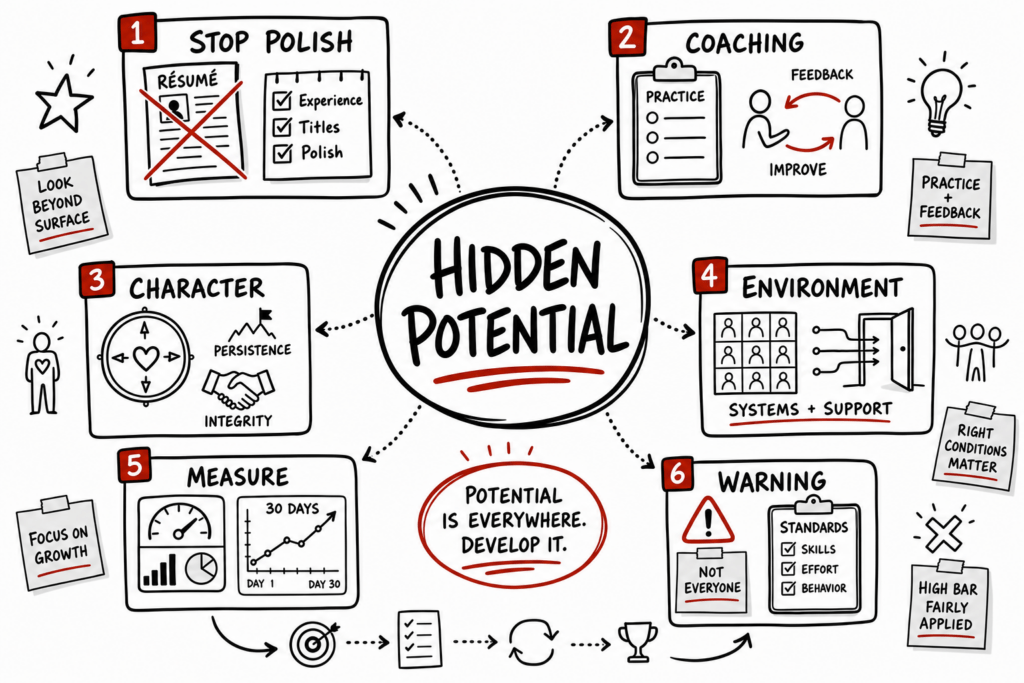
The most useful Adam Grant Hidden Potential takeaways for luxury brokerage leaders are about replacing “spot-the-star” hiring with evidence-based coaching systems that build capability across the team. In Hidden Potential, Adam Grant argues that performance is not a fixed trait; it is shaped by character skills, learning conditions, feedback, and opportunity design. For managers, coaches, and brokerage owners, the strategic implication is clear: stop treating polished résumés as the main proxy for future production and start measuring coachability, practice quality, and improvement velocity. A practical KPI is 90-day skill gain: track whether a new agent improves conversion rate, listing-presentation quality, CRM follow-up consistency, or referral outreach volume after structured coaching. This is not a motivational book about believing in everyone. It is a talent-development framework for deciding where potential is underused, what support unlocks it, and when a leader should invest more coaching time.
Hidden Potential book review: the private briefing version
Hidden Potential by Adam Grant is not really a book about talent. It is a book about the conditions that make talent visible. That distinction matters if you lead a brokerage, manage a sales team, coach agents, or decide who gets your time, your referrals, your listings, and your patience.
The standard leadership mistake is assuming the best future performers are the people who already look impressive. Grant challenges that instinct. His case is that potential often hides behind uneven education, imperfect confidence, rough presentation skills, or simply the absence of a good coach. The strongest parts of the book translate well into real estate because brokerages are full of people whose results depend on training quality, feedback loops, emotional stamina, and access to opportunity.
For readers wanting a clean Hidden Potential book summary, here it is: Grant argues that growth depends less on innate genius and more on character skills, support structures, and systems that reward learning. The book blends research, stories, and practical language in the familiar Adam Grant style. If you want publisher context, the official page is here: Penguin Random House: Hidden Potential. Grant’s own book page is also useful for author framing: Adam Grant: Hidden Potential.
Who Should Read It
This is a strong book fit for managers and coaches who are responsible for building other people’s capability, not just evaluating finished performance. Brokerage owners, team leaders, productivity coaches, sales managers, and learning-and-development leads will get the most direct value.
It is especially relevant if your brokerage is wrestling with one of these problems: expensive recruiting that produces uneven retention, new agents who stall after onboarding, high performers who resist coaching, or a leadership bench that depends too heavily on a few charismatic producers. The book gives you language for moving from personality-based talent judgment to more disciplined development.
It is less ideal if you want a real-estate-specific operating manual. Grant is not writing for brokerages. You will need to translate his ideas into your hiring scorecards, coaching cadence, pipeline reviews, listing-presentation training, and accountability rhythms. That translation is worth doing, but the book will not do it for you.
Core Idea
The core idea is simple but demanding: potential is not something leaders merely discover; it is something leaders help create. Grant pushes against the lazy version of meritocracy, where leaders reward whoever already looks polished and then call that objectivity.
For brokerage leaders, the point lands hard. Many firms recruit for confidence, market knowledge, luxury polish, social ease, and a strong existing network. Those qualities matter. But they can also cause leaders to overlook agents who may become excellent with better practice design and clearer feedback. A candidate with moderate polish but high learning speed, disciplined follow-up, humility, and resilience may outperform the “natural” who resists instruction.
This is where the leadership lessons from Hidden Potential become practical. The manager’s job is not to lower standards. It is to improve the system that helps people meet them. That means defining the skills that matter, observing behavior, coaching specifically, and measuring whether the person improves after feedback. Potential without progress is sentiment. Progress after structured challenge is evidence.
Adam Grant Hidden Potential takeaways for brokerage leaders
1. Stop confusing early polish with long-term upside
In real estate, especially luxury, polish can be seductive. A candidate may interview beautifully, know the right neighborhoods, and speak the language of affluent clients. That does not mean they will prospect consistently, handle rejection well, negotiate under pressure, or follow through for two years without applause.
The better question is: how does this person respond to instruction, ambiguity, and discomfort? One of the best Hidden Potential key takeaways is that leaders should look for evidence of learning capacity, not just evidence of past access. In hiring, ask candidates to complete a practical exercise, receive feedback, revise it, and explain what they changed. That shows more than a résumé full of impressive adjectives.
2. Build coaching around specific behaviors
Grant’s work supports a move away from vague encouragement. “You have potential” is not a coaching plan. “Your listing presentation loses momentum after pricing; let’s rehearse the pricing objection three times and track seller response rate over the next 30 days” is a plan.
For brokerage teams, evidence-based coaching should target observable behaviors: number of quality follow-ups, speed to lead response, listing appointment conversion, buyer consultation completion, pricing conversation confidence, database segmentation, and referral request consistency. The goal is not more meetings. The goal is faster skill acquisition.
3. Treat character skills as performance skills
One of the better strategy lessons from Hidden Potential is that character is not decorative. Traits like persistence, humility, proactivity, and willingness to seek help have operational value. They affect pipeline quality, client trust, agent retention, and team standards.
Brokerage leaders can make this concrete by building character skills into review conversations. Instead of only asking, “How many appointments did you set?” ask, “What feedback did you act on this week?” “Where did you practice before going live with a client?” “What did you do after the lead went cold?” These questions reveal whether someone is learning or merely hoping.
4. Design environments that surface hidden strengths
A useful Adam Grant book review should say this plainly: the book is strongest when it shifts responsibility from individual willpower to leadership design. Some agents underperform because they are not capable. Others underperform because the office has no real practice culture, unclear standards, weak mentorship, or feedback that arrives too late.
Leaders can surface hidden strengths by using structured role-play, peer review, call listening, listing-presentation labs, market-analysis workshops, and short-cycle coaching sprints. These tools reduce the randomness of development. They also make it easier to see who improves when the environment gets better.
Best Takeaways
The best takeaway is that talent development should be treated as a management system, not a personality bet. A serious brokerage should be able to answer four questions: What skills create production here? How do we teach them? How do we measure improvement? Who improves fastest when coached?
A second strong takeaway is that opportunity allocation deserves scrutiny. In many firms, the same trusted people get the best leads, the best mentors, and the most visibility. That may be rational in the short term, but it can quietly cap the organization’s future. If you never test emerging agents with meaningful chances, you cannot know who is ready.
A third takeaway is the value of “improvement velocity.” This is not Grant’s only language, but it is the managerial translation I would use. Improvement velocity means the rate at which someone gets better after targeted coaching. In a brokerage, a practical version might be: after four weeks of structured listing coaching, did the agent improve presentation score, seller objection handling, and appointment-to-agreement conversion? That is more useful than asking whether they “seem promising.”
Where It Falls Short
My main caution in this Adam Grant Hidden Potential review is that the book can make development sound cleaner than it feels inside a business. Leaders still have finite time, uneven margins, impatient clients, and agents who say they want coaching but do not change behavior. Believing in hidden potential does not remove the need for standards.
The book is also broad. That is part of its appeal, but ambitious operators may want more detail on implementation. If you already understand growth mindset, feedback culture, and deliberate practice, some sections may feel familiar. The value is less in one shocking new concept and more in the way Grant packages research into a usable leadership lens.
Another caveat: not every gap is a development opportunity. Some people lack the desire, ethics, discipline, or client-care standards required for high-trust work. A luxury brokerage cannot turn every struggling agent into a strong performer without risking brand damage. The practical reading is not “coach everyone forever.” It is “judge potential by response to the right support.”
How to Apply It
Use a potential scorecard in hiring
Add a simple scorecard to interviews and auditions. Rate candidates on coachability, preparation, resilience, client empathy, follow-through, market curiosity, and improvement after feedback. Keep the scoring specific. For example: “revised presentation based on feedback within 24 hours” is stronger than “seems coachable.”
Create 30-day coaching sprints
Pick one high-value skill at a time. For new agents, it might be speed-to-lead and follow-up quality. For mid-level agents, it might be listing conversion. For senior agents, it might be delegation, negotiation depth, or client experience consistency. Define the baseline, run weekly practice, give narrow feedback, and measure change.
Separate confidence from competence
Luxury environments reward confidence, but confidence can mask weak fundamentals. Require evidence. Listen to calls. Review CMAs. Audit follow-up. Watch role-plays. The goal is not surveillance; it is precision. Better diagnosis produces better coaching.
Promote managers who develop people
If your leaders are only rewarded for personal production, development will remain optional. Add manager KPIs tied to agent retention, ramp time, skill progression, and internal promotions. This is where talent development frameworks become business strategy, not HR language.
Final Verdict
Hidden Potential is worth reading if you lead people and want a sharper way to think about capability. The book will not hand you a brokerage playbook, but it will challenge lazy talent assumptions and push you toward better systems. For real-estate leaders, the practical move is to stop asking, “Who already looks like a star?” and start asking, “Who improves fastest under the right conditions, and how do we build more of those conditions?”
That is the business value of the book. It reframes talent as something leaders can test, coach, and scale. Used well, it can improve hiring decisions, onboarding quality, coaching conversations, and the depth of your future leadership bench.
For more RE Luxe Leaders strategy briefings on books, brokerage growth, and high-performance leadership, keep reading the latest reviews—or book a confidential strategy call when you are ready to translate the ideas into your own team model.