
AI for Good Summary: Practical AI Lessons for Leaders
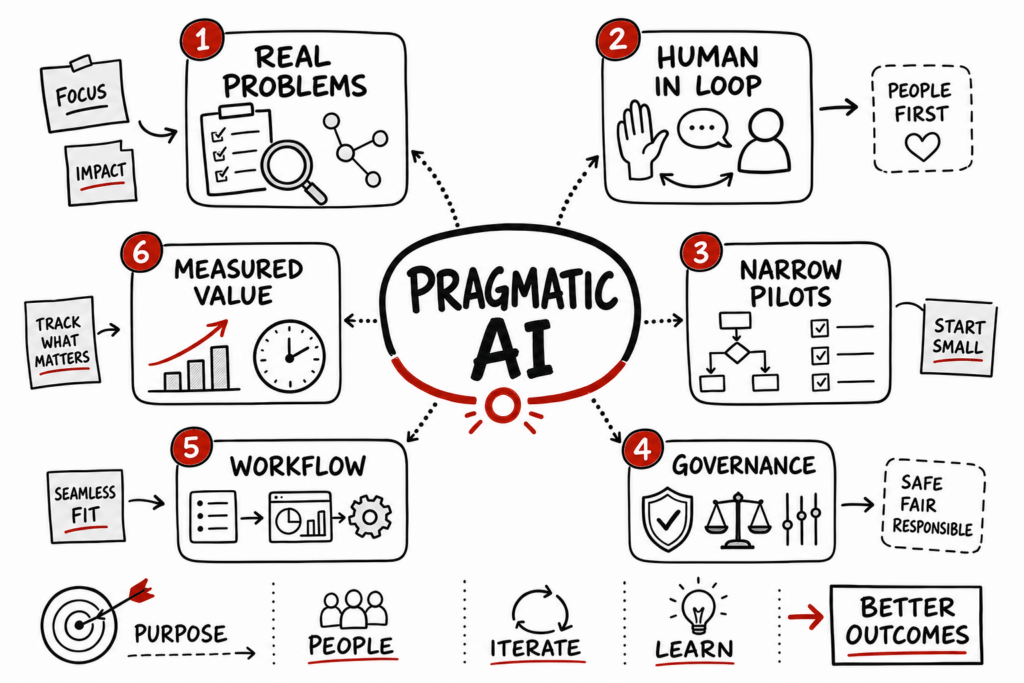
Short answer: AI for Good: How Real People Are Using Artificial Intelligence to Fix Things That Matter, presented in the source as Josh Tyrangiel’s book, is most useful as a field guide to practical, human-scale AI. Its focus is a defined problem, a real user, a feedback loop and a result that can be tested.
This review is for leaders who want AI literacy without buying a grand forecast. The book’s useful question is where a specific workflow, if redesigned with care, could serve people better.
AI for Good Summary: What the Book Is Really Arguing
The book’s central argument is that meaningful AI work begins with a problem that can be clearly defined, measured and improved. It uses practical examples rather than asking the reader to rely on abstract capability claims.
The reading angle for an executive is not “Should this be inspiring?” It is “What patterns repeat across useful deployments?” The source emphasizes a specific use case, an understood data environment, human judgment and a willingness to redesign the workflow rather than attach software to an unchanged process.
Who Should Read It
This is a fit for founders, real-estate principals, family-office operators, nonprofit executives, investors and senior managers who need AI literacy without becoming machine-learning specialists. Technical readers seeking model architecture will need a different companion.
It is also useful when an organization is surrounded by AI pitches. Replace “What can AI do?” with “Where do we have a costly, repetitive, data-rich or decision-heavy problem where better classification or pattern recognition could help?”
In a relationship-led business, AI may support lead triage, document workflows, risk review, market monitoring, vendor coordination or portfolio analysis. The book encourages concrete questions while leaving the final design and governance to the organization.
Core Idea
AI becomes useful when it is attached to a problem with operational, economic or human clarity. Beneficial use still needs discipline: a defined user, an accountable owner, a feedback loop and a measure that can be tested.
Start with friction. Where are skilled people wasting time? Where are decisions made with incomplete information? Where are customers underserved because the organization cannot see patterns quickly enough? Where does risk remain hidden until it becomes expensive?
Best Takeaways
1. Useful AI starts with a narrow problem
Specificity beats ambition. A broad mandate to “use AI across the business” creates confusion. A narrow problem lets the team name the pain, identify inputs, define a test and decide what will happen if the test is useful.
2. Human context is not optional
People close to the work understand which errors matter, which recommendations are impractical and which edge cases carry reputational risk. Brokers, advisers, analysts, operators and service professionals should shape the use case and the override path.
3. “Good” AI still needs governance
Good intentions do not answer who is accountable, what data is used, how quality is checked, when a human must intervene or how a person can challenge an output. Those questions belong in the design before the pilot starts.
4. Case studies are more useful than predictions
Deployment examples can show the difference between a plausible pilot and a theatrical demo. They do not prove that another organization will obtain the same result. Use them to generate questions about fit, evidence, cost and risk.
5. AI adoption is a management challenge
Organizations can fail because leaders do not choose priorities, clean up processes, align teams or allow time for learning. The technology is only one part of the operating decision. Ownership and workflow design carry the rest.
Where It Falls Short
A case-driven book may leave the reader wanting a harder framework for investment criteria, pilot design, vendor review, compliance or change management. Readers should translate each example into their own evidence and constraints.
The phrase “AI for good” should not soften diligence. A socially valuable use can still raise questions about privacy, consent, accuracy, cost and unintended consequences. Inspirational examples may also hide fragmented data, resistance, legacy systems and implementation drag.
This is an executive briefing rather than a technical guide. Its value is framing and observation; it cannot replace responsible product, legal, privacy, security or operational review.
How to Apply It
Use the book as a filter for possible pilots. Ask five questions.
Is the problem specific? “Improve client experience” is too broad. “Reduce response time for high-intent inquiries while maintaining the service standard” is a testable direction.
Is there usable data? Audit where the inputs live, who can access them and whether the records are accurate enough for the proposed task.
Would better classification or prediction change a decision? Look for earlier detection, faster triage, sharper prioritization or fewer avoidable handoffs.
Who is the human in the loop? Assign an owner who knows when to trust, challenge, override and improve the system.
How will success be measured? Define time saved, error reduction, cost avoidance, risk reduction, service quality or another decision-relevant measure before the pilot begins.
Then create a small opportunity map. List recurring problems, score pain, data readiness, risk and ease of testing, and choose one or two bounded pilots. Review results after a fixed period. Scale only what proves useful for the actual people and workflow involved.
Final Verdict
AI for Good is worth reading for grounded optimism with room for skepticism. It shifts AI from a status conversation toward an operating question: where is the problem real, and what would responsible improvement look like?
Read the examples as prompts, then bring your own evidence, governance and accountability to the next decision.
You can request a complimentary one-hour conversation with a senior advisor who is an experienced operator. Talk through your next move when you need to pressure-test where AI, judgment and workflow design belong.