Is This Building a Second Brain Review Useful for Real Estate Leaders?
Yes: this Building a Second Brain review is most useful for real estate executives, founders, and ambitious operators who manage too much information and need a cleaner decision system. Building a Second Brain by Tiago Forte argues that your digital notes should not be a storage closet; they should be a working asset that helps you capture, organize, retrieve, and use knowledge when stakes are high. The strategic implication is simple: if your deal notes, market observations, client insights, meeting takeaways, and leadership ideas are scattered across email, texts, apps, and memory, you are carrying operational risk. Forte’s Second Brain method defines a personal knowledge management system as an external, searchable place for ideas and evidence. A practical KPI: if you cannot retrieve a key note, precedent, or decision rationale in under two minutes, your system is not supporting executive performance.
Book Overview
Tiago Forte is a productivity educator and founder of Forte Labs, and his book arrived at the right moment: professionals were already drowning in information before AI made content creation nearly frictionless. The official book page at Forte Labs frames the book as a method for saving and using the best of what you consume, think, and create.
This is not a book about journaling, motivation, or aesthetic note-taking. It is a book about building a digital note-taking system that reduces cognitive load. Forte’s core claim is that modern work demands more than memory. Professionals need a trusted external system where ideas can compound over time.
As a Tiago Forte book review, the fair positioning is this: Building a Second Brain sits between productivity, creativity, and knowledge operations. It is more practical than most “think better” books, but less tailored than an industry-specific operating manual. The value depends on whether you actually implement the workflow instead of just admiring the framework.
Who Should Read It
This book is a strong fit for leaders whose work depends on pattern recognition: real estate principals, brokerage owners, asset managers, developers, capital advisors, consultants, and founders building remote or hybrid teams. If your week includes investor conversations, property tours, financial assumptions, vendor negotiations, leadership meetings, and market research, you are already running an informal knowledge system. The question is whether it is deliberate or chaotic.
Building a Second Brain for real estate leaders is especially relevant because real estate decisions rarely depend on one clean data point. They depend on fragments: lender sentiment, buyer psychology, construction cost signals, municipal politics, neighborhood momentum, tenant behavior, and lessons from prior deals. A good personal knowledge management system helps you preserve those fragments before they disappear.
The book is also useful for executives managing distributed teams. Remote leadership creates more written communication, more asynchronous updates, and more decisions made through digital trails. A Second Brain can become the leader’s private context engine: not a replacement for CRM, project management, or financial systems, but a layer above them where interpretation and judgment live.
Skip or skim it if you already have a mature knowledge management workflow and only want advanced automation. Forte’s method is accessible by design. That is a strength for busy professionals, but power users may find parts familiar.
Core Idea
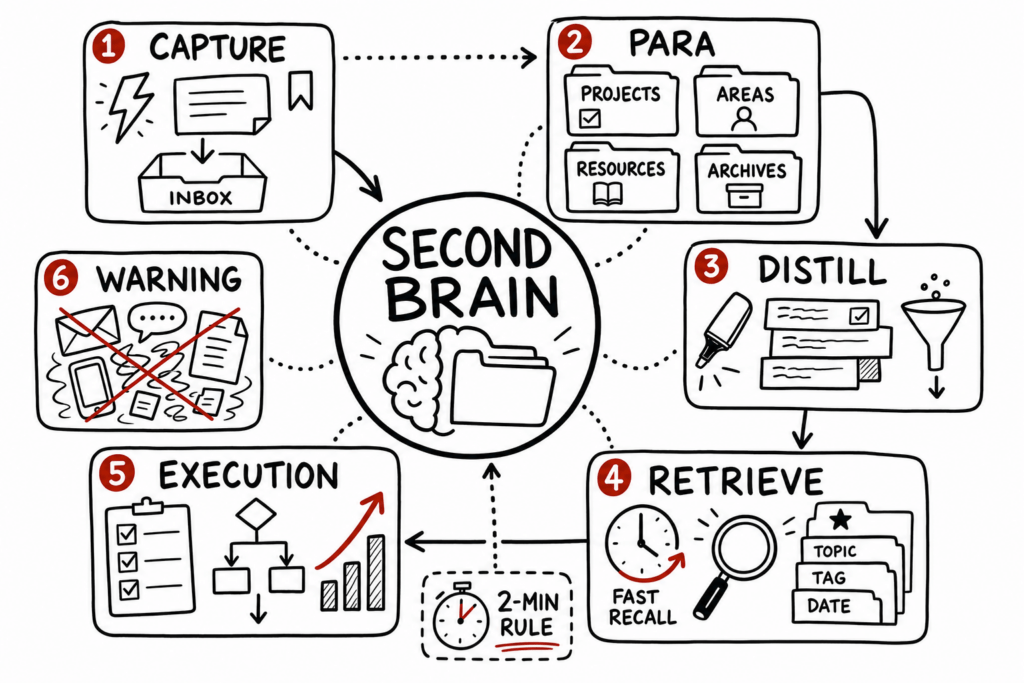
The Building a Second Brain summary is straightforward: capture what matters, organize it for action, distill it into useful form, and express it through projects, decisions, and creative output. Forte calls this the CODE framework: Capture, Organize, Distill, Express.
The shift is subtle but important. Most people organize information by where it came from: articles, meetings, podcasts, PDFs, screenshots, conference notes. Forte recommends organizing by where it will be used. That means your notes should support active projects, areas of responsibility, resources, and archives rather than becoming a museum of interesting material.
This is where the book moves from productivity advice into strategy. Executives do not need more saved content. They need better retrieval at the moment of choice. A real estate CEO reviewing a potential acquisition should be able to pull prior underwriting lessons, neighborhood intelligence, lender feedback, and comparable investor objections without digging through six tools.
Forte’s method also recognizes that creative work is not lightning in a bottle. It is assembly. Better memos, presentations, investor letters, team trainings, listing narratives, and strategic plans often come from recombining notes captured over months. That is one of the strongest strategy lessons from Building a Second Brain: your intellectual edge depends less on consuming more and more on reusing what you already know.
Best Takeaways
1. Capture with restraint, not panic
The book does not argue that everything deserves to be saved. The better question is: “Will this help my future self make a decision, explain an idea, avoid a mistake, or create something valuable?” For executives, that filter is essential. Capture the insight, not the noise.
In real estate, useful captures might include: a lender’s offhand comment about tightening credit, a buyer objection repeated across showings, a construction delay pattern, a zoning risk, a board conversation that reveals investor priorities, or a post-mortem from a failed pursuit.
2. Organize around outcomes
The PARA structure—Projects, Areas, Resources, Archives—is one of the book’s most useful tools. Projects are active outcomes with deadlines. Areas are ongoing responsibilities. Resources are reference topics. Archives hold inactive material. The PARA method is valuable because it reflects how executives actually work: not by neat subject categories, but by moving priorities.
For a real estate leader, “Q2 investor update” is a project. “Capital relationships” is an area. “Adaptive reuse trends” is a resource. “2021 acquisition pipeline” is archive material. That distinction prevents everything from feeling equally urgent.
3. Distill notes into decision-ready assets
This is one of the most underrated Building a Second Brain key takeaways. Saving a 4,000-word article is less useful than highlighting the three lines that change how you think. Forte encourages progressive summarization: make notes easier to use each time you touch them.
For busy leaders, this matters because future you will not have time to reread everything. A strong note should reveal its value quickly. If it takes ten minutes to understand why you saved it, the system is creating friction instead of leverage.
4. Treat knowledge as an execution asset
The strongest leadership lessons from Building a Second Brain are not about apps. They are about reducing repeat thinking. Leaders lose time when they repeatedly rebuild the same explanation, rationale, checklist, or lesson. A Second Brain turns those recurring thoughts into reusable assets.
Examples: a template for explaining cap rate movement to clients, a checklist for evaluating a property management partner, a post-closing debrief structure, or a leadership note on how your team handles urgent client escalations.
Where It Falls Short
The book can make the method sound cleaner than real life. Information does not always arrive in calm, capturable moments. Senior leaders receive critical context in hallway conversations, phone calls, client dinners, voice notes, and rapid-fire negotiations. The system only works if you build low-friction capture habits that match your actual day.
Another limitation: the book is tool-agnostic, which is philosophically sound but can leave some readers wanting more implementation detail. Forte is right not to make the method dependent on one app. Still, executives often need a sharper recommendation architecture: what belongs in notes, what belongs in CRM, what belongs in project management, and what belongs in secure document storage.
There is also a risk of over-engineering. Some readers will turn the Second Brain method into another productivity hobby. That misses the point. The goal is not to build the perfect vault. The goal is faster recall, better decisions, clearer communication, and more consistent execution.
So, is Building a Second Brain worth reading? Yes, if you are willing to implement a simple version within one week. No, if you are looking for an app to magically solve unclear priorities. The system amplifies judgment; it does not replace it.
How to Apply It
Start with one executive use case
Do not reorganize your entire digital life on day one. Pick one high-value use case. For real estate leaders, good starting points include investor communications, acquisition research, recruiting intelligence, client objections, market commentary, or leadership operating principles.
Create one folder or workspace for that use case. Capture only material that improves future decisions or output. After two weeks, review what you saved and delete anything that does not earn its keep.
Use a two-minute retrieval standard
A practical standard for knowledge management for executives: if a note is important, you should be able to find it in under two minutes. If not, simplify names, tags, folders, or search conventions. This KPI keeps the system honest. A beautiful archive that cannot be searched quickly is not an executive tool.
Turn recurring thinking into reusable blocks
Look for ideas you explain repeatedly. These are prime Second Brain assets. Examples include your investment philosophy, seller consultation talking points, deal-screening criteria, market risk language, onboarding notes for new leaders, and your framework for deciding when to walk away from a transaction.
Every time you refine one of these explanations, save the stronger version. Over time, your system becomes a private library of judgment.
Connect notes to projects
Before saving anything, ask: “What project, decision, or responsibility could this support?” If there is no answer, do not capture it. This single habit prevents the common personal knowledge management failure: collecting interesting material that never becomes useful.
Schedule a weekly review
Forte’s method depends on review. Set a 30-minute weekly appointment to process inbox notes, move items into the right project or area, and identify what can be turned into an asset. For executives, Friday afternoon or Monday morning works well because it connects knowledge to priorities.
Final Verdict
Building a Second Brain is not overhyped if you read it as an operating philosophy for attention, memory, and reuse. It is overhyped only when treated as a promise that a note-taking app will create discipline for you.
The best reason to read it is not to become “more organized.” It is to stop losing valuable thinking. For real estate executives and ambitious professionals, the edge is not just access to information. Everyone has that. The edge is converting information into timely judgment, clearer communication, and repeatable strategic output.
For more private-briefing style reviews and leadership strategy notes, read more from RE Luxe Leaders—or book a confidential strategy call if your firm needs sharper executive messaging, positioning, or decision support.