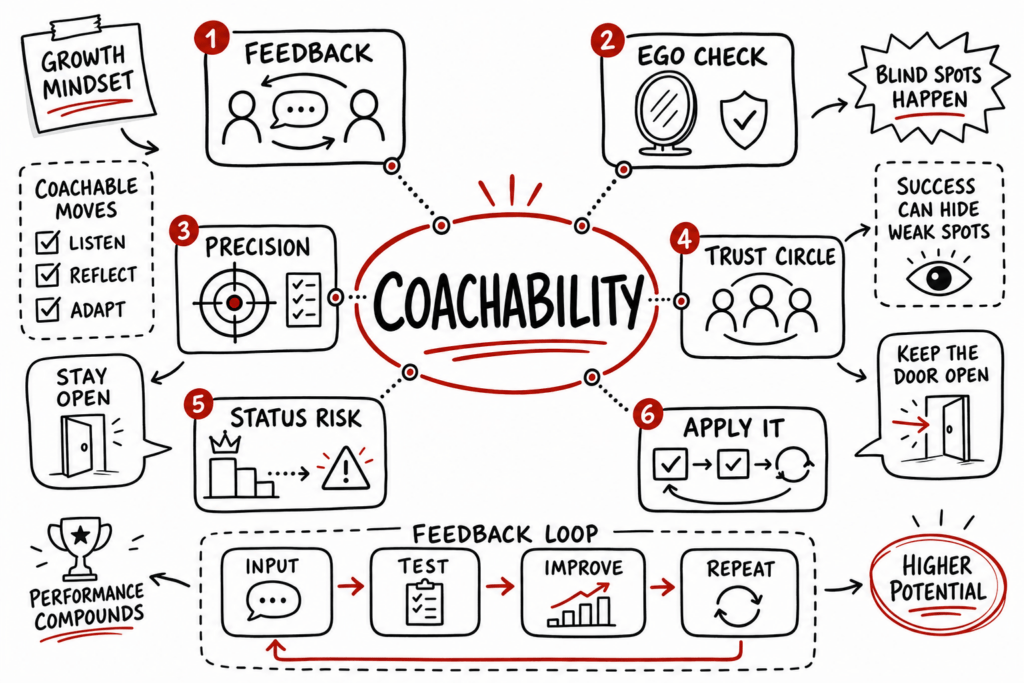
Coachable book summary: Ric Bucher argues that elite performance is not just a product of talent, discipline, or ambition. The real separator is coachability: the ability to hear hard feedback, test it without ego, and turn outside guidance into better execution. For leaders, the book is most useful as a mirror. If you are already successful, the question is not whether you have potential. The question is whether your identity can survive being improved.
Coachable book summary: The private briefing
Coachable: How the Greatest Performers Reach Their Highest Potential sits in a growing category of performance psychology books aimed at ambitious professionals who have already mastered the basics. It is not a tactical management manual. It is closer to a field report on what separates high performers who keep evolving from high performers who plateau once talent, reputation, or status start protecting them from discomfort.
Ric Bucher, known for his long career covering professional basketball and elite athletes, uses the sports world as his primary lens. That makes the book accessible and culturally fluent for executives who enjoy performance stories, but the deeper point travels well beyond athletics. In wealth, real estate, entrepreneurship, investing, and leadership, the same issue appears: the higher you rise, the fewer people tell you the truth cleanly. Coachability becomes a form of strategic advantage.
This Coachable Ric Bucher summary is spoiler-free. The value here is not in retelling the book’s examples scene by scene. The value is in extracting the operating lesson: your next level may depend less on finding better advice and more on becoming the kind of person who can actually use it.
Who Should Read It
Read Coachable if you are a founder, senior executive, team leader, advisor, broker, investor, or ambitious professional who has outgrown generic motivation but still wants to get sharper. This is especially relevant if you are in a role where your results depend on judgment under pressure, fast adaptation, and the ability to work with strong personalities.
The book fits readers looking for an executive leadership book review, a performance psychology book summary, or practical book summary leadership lessons without academic density. It will also appeal to professionals who follow elite sports because Bucher’s background gives the material a narrative pace that many leadership books lack.
It is less ideal if you want frameworks, worksheets, or a step-by-step coaching system. The book is more reflective than procedural. It gives you patterns to notice, not a complete operating manual.
Core Idea
The core idea is simple but uncomfortable: talent gets attention, but coachability compounds. Many people say they want feedback. Far fewer can receive feedback without defending, minimizing, rationalizing, or quietly dismissing it. Bucher’s strongest argument is that the best performers do not merely tolerate coaching. They develop an active appetite for correction because they understand that feedback is information, not an indictment.
That distinction matters for leaders. At the executive level, ego rarely looks like obvious arrogance. It often looks like speed, certainty, taste, experience, or high standards. A founder may dismiss input because the advisor lacks context. A real estate leader may reject a market warning because past cycles rewarded conviction. A top producer may avoid coaching because their numbers already outperform the room. In each case, success becomes evidence against change.
That is where coachability in leadership becomes a high-value meta-skill. It is the capacity to separate your self-worth from your current method. If your identity depends on already being right, coaching will feel like a threat. If your identity depends on getting better, coaching becomes leverage.
Best Takeaways
1. Feedback only works when the receiver is ready
One of the strongest Coachable key takeaways is that great advice is not automatically useful. Timing, trust, delivery, and the receiver’s emotional state all matter. Leaders often spend too much time asking whether they have the right coach, consultant, board member, or mentor. Bucher’s deeper challenge is more personal: are you in a condition to metabolize what they are telling you?
For executives, this is a practical warning. If every piece of challenging feedback turns into a debate, your team will eventually stop giving you the clean version. You may still get updates, but you will not get the truth early enough to act on it.
2. The best performers seek precision, not praise
High performers can enjoy recognition, but they do not depend on it as their primary fuel. Bucher shows that elite development comes from a hunger for precise correction. The question shifts from, did I do well, to, what specifically can be better?
This is one of the most useful Coachable performance lessons for business. In luxury real estate, capital advisory, brand building, and founder-led companies, vague compliments are seductive and mostly useless. Precision creates improvement. A sharper listing presentation, a better investor update, a cleaner negotiation process, a more disciplined hiring filter: all of these improve through specific feedback, not applause.
3. Coachability is not compliance
The book is careful not to confuse being coachable with being passive. Strong performers do not blindly obey every instruction. They listen, test, adapt, and integrate. That nuance matters. Executives often resist coaching because they associate it with surrendering authority. Bucher’s better framing is that coachability is a disciplined way to process outside intelligence.
You are not outsourcing your judgment. You are improving the inputs your judgment can use.
4. Status can quietly reduce learning speed
The higher you go, the more insulated you become. People soften the message. Advisors manage your mood. Employees protect access. Clients may admire your confidence more than your accuracy. Bucher’s sports lens makes this dynamic easy to see, but it is just as common in boardrooms and family offices.
This is why the book belongs on high-net-worth and executive reading lists. Publications such as CNBC regularly cover the pressure on leaders to adapt in volatile markets, while institutions like J.P. Morgan emphasize the importance of disciplined decision-making across cycles. Coachability supports both: it keeps leaders from confusing past success with current accuracy.
Coachable leadership lessons for founders and executives
The most practical leadership lesson is to build a feedback environment before you need it. Under pressure, people rarely rise into perfect openness. They default to their trained habits. If your normal habit is defensiveness, stress will amplify it. If your normal habit is curiosity, stress will still be uncomfortable, but you will have a better chance of hearing the signal.
For founders, this means choosing advisors who are not just impressive, but willing to challenge you. For executives, it means rewarding people who surface problems early. For real estate leaders, it means inviting market feedback before pricing, positioning, or client strategy hardens into ego. For investors, it means studying disconfirming evidence before a thesis becomes personal.
The best use of this book is not to ask whether your team is coachable. Start with yourself. Your organization often mirrors the behavior you normalize.
Where It Falls Short
The main limitation of Coachable is that it can feel stronger as a concept than as a toolkit. Bucher is persuasive on why coachability matters, and his sports-informed storytelling makes the idea memorable. But readers looking for a highly structured implementation system may want more templates, diagnostic questions, or leadership exercises.
There is also a risk that readers will over-associate the lessons with athletes. The sports examples are useful, but business leaders need to translate them carefully. A locker room, a sales organization, an investment committee, and a founder-led company all have different power dynamics. Feedback travels differently in each environment.
Finally, the book’s central idea is easy to admire and hard to practice. Many readers will finish agreeing with the premise. Fewer will change how they behave when criticized by a peer, partner, spouse, board member, or direct report. That is not a flaw unique to Bucher. It is the nature of the subject.
How to Apply It
Use the book as a behavioral audit. Do not just underline the parts that sound wise. Watch what happens the next time someone questions your judgment.
- Create a feedback rule: When receiving criticism, ask two clarifying questions before explaining your position. This slows the defensive reflex.
- Separate tone from content: The delivery may be imperfect and the insight may still be valuable. Mature leaders can extract signal without needing perfect packaging.
- Choose one performance lane: Pick a specific area such as negotiation, hiring, client communication, investor reporting, or decision speed. Ask for precise feedback there.
- Build a truth circle: Identify three people who have context, competence, and permission to be direct. Make candor part of the relationship before stakes rise.
- Track applied feedback: The measure of coachability is not how well you listen in the moment. It is whether your behavior changes afterward.
For affluent professionals, the highest-value application may be in decision hygiene. Wealth and success can buy access, but they can also buy insulation. Coachability keeps the door open to correction when your environment starts rewarding certainty over learning.
Final Verdict: Is Coachable worth reading?
Yes, if you want a concise, accessible performance read that reframes feedback as a competitive edge. This Coachable book review lands on a practical conclusion: the book is not revolutionary in structure, but it is timely and useful because the subject is under-discussed among successful people. Most leadership content focuses on how to lead others. Bucher’s book asks whether you can still be led, sharpened, and improved.
That question is worth sitting with. The higher your performance level, the more expensive your blind spots become. Coachable is a smart addition to a leadership reading stack for anyone serious about durable excellence, especially readers interested in a high performer mindset book with lessons that cross from sports into business.
For more sharp strategy briefings like this, explore RE Luxe Leaders’ latest book reviews and leadership notes. If you are navigating a high-stakes growth, positioning, or market decision, you can also book a confidential strategy call.