
Crisis Engineering Summary: Tools for Leading Through Chaos
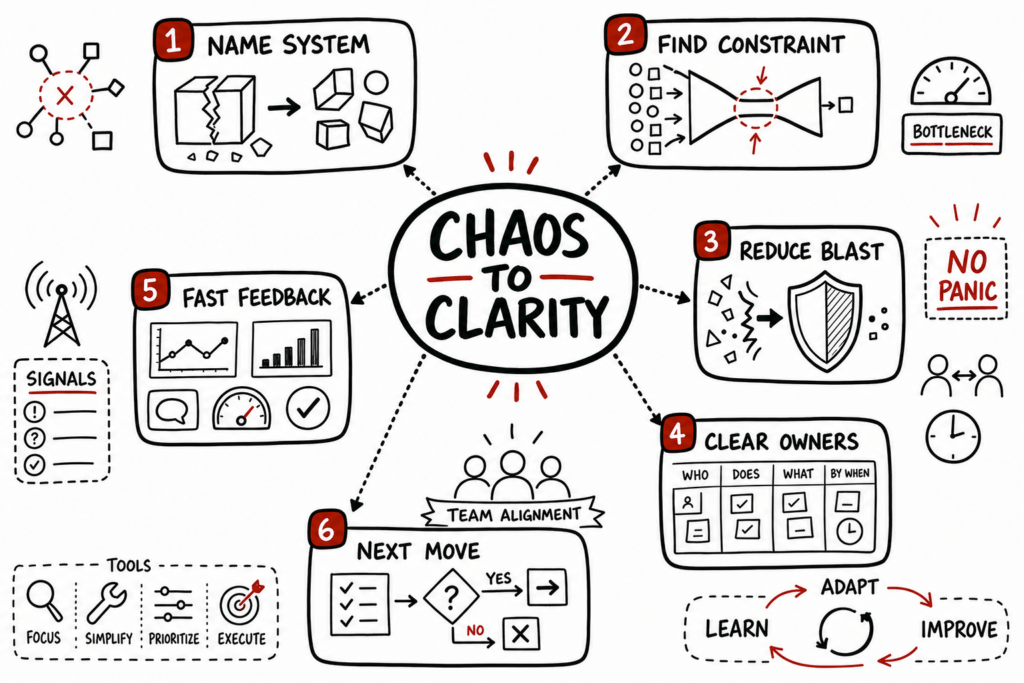
Short answer: Crisis Engineering: Time-Tested Tools for Turning Chaos into Clarity treats crisis response as a practice that can be designed. Marina Nitze, Matthew Weaver and Mikey Dickerson focus on breaking a messy situation into visible parts, finding the constraint, making ownership clear and creating a fast feedback loop.
This review is useful for leaders who work inside complex systems. It treats the book as an operating guide: clarify the next objective, separate facts from assumptions and create a credible next move while the situation is still changing.
Crisis Engineering Summary: Why It Matters Now
The book’s useful premise is that calm often follows structure. When leaders can frame a problem, separate signal from noise and sequence the next actions, they have more room to act without relying on adrenaline.
Slow-burn crises appear in many settings: a founder may be balancing cash flow, talent, customer trust and board expectations; a real-estate operator may be balancing financing, contractors, tenants, regulation and reputation. The leader’s task is to rebuild a working map while the ground is moving.
Core Idea
Crisis management improves when a crisis is treated as an engineering problem rather than an emotional weather event. That does not remove empathy. It keeps emotion from becoming the only operating system.
In this framing, a crisis is a situation where normal processes stop producing useful clarity. Information may be missing, contradictory or too abundant. People may be busy without making progress. The leader must clarify what needs to be true next, who owns it, what information is needed and how quickly the team can learn whether the move is working.
The practical sequence is straightforward: clarify the objective, expose assumptions, isolate the bottleneck, shorten the feedback loop and keep moving without pretending certainty exists.
Best Takeaways
1. Name the system before you try to fix the symptom
The urgent complaint, broken dashboard, delayed closing or missed launch demands attention, but it may be a symptom. Ask what system produced it and which part is failing under stress. The cause may be unclear sequencing, hidden dependencies, overloaded decision rights, poor intake or a measure that rewards the wrong behavior.
2. Reduce the blast radius
Good crisis leadership does not always begin with a perfect answer. It often begins by limiting damage while the answer becomes clearer. Ask what can pause, what must continue, which move is reversible and what must not spread. Speed is useful when it preserves options; reckless speed burns them.
3. Make ownership painfully clear
Write down who decides, who informs, who executes, who tracks and who can say no. Capable teams can hide dysfunction under good intentions because everyone assumes someone else is handling the missing piece. Visible ownership turns responsibility into an operating design.
4. Prefer live feedback over polished certainty
When a system is unstable, a polished report may already be stale. Build a truth pipeline with short check-ins, clear escalation paths and direct contact with the operational edge of the problem. The goal is accurate status, current blockers and the next test, not reassurance.
Who Should Read It
Crisis Engineering suits founders, operators, executives, senior managers, consultants, product leaders, public-sector problem solvers and real-estate professionals who coordinate fragile systems. It also helps an ambitious professional become the person others trust when a plan breaks.
Readers looking for motivational storytelling may find it too operational. Readers who want a practical way to run toward a messy problem without being consumed by it will find a stronger fit.
Where It Falls Short
The book’s tool-driven approach is also its limitation. It gives less space to the emotional, political and status dynamics that affect how a team receives a crisis process. A checklist cannot repair a culture that punishes bad news, and a framework becomes performance theater when leaders use the language without changing behavior.
Leaders should also avoid putting every inconvenience into crisis mode. Mature operations include knowing when to mobilize intensity and when to let normal systems do their work.
How to Apply It
When a situation feels chaotic, start with five questions.
What is the actual objective now? Name the next meaningful outcome, whether that is preserving lender confidence, restoring client trust or clarifying decision rights.
What do we know, assume and need to learn next? Separate evidence from anxiety and assign the next information-gathering step.
Where is the constraint? Identify whether information, authority, capacity, sequencing or trust is limiting progress.
Who owns the next move? Assign the action, deadline, decision authority and feedback point to a named role.
What is the shortest credible feedback loop? Learn as soon as the decision allows, then adjust from what the test shows.
For a practical implementation, write a one-page crisis protocol. Define crisis levels, who convenes the room, which information is needed first, how updates are delivered and when an after-action review occurs. Review the protocol after a real event and revise it from evidence.
Final Verdict
Crisis Engineering is a grounded manual for leaders who understand that complexity is part of the job. Its strongest contribution is the reminder that clarity is built through structure, ownership and feedback.
Read it as operating infrastructure rather than inspiration. Translate the useful tools into meetings, escalation paths and decision rights, then adapt them to the actual people and stakes in your organization.
You can request a complimentary one-hour conversation with a senior advisor who is an experienced operator. Talk through your next move when a complex business, brand or real-estate decision needs a clear outside conversation.