
Die with Zero Summary: Wealth Timing for Real Estate Leaders
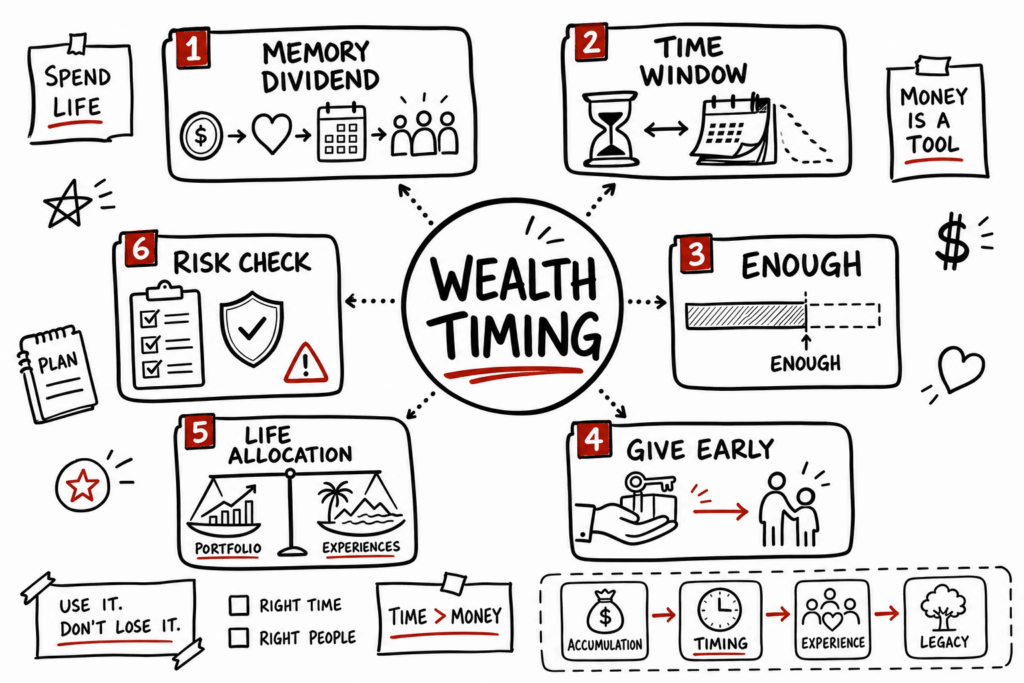
What Is the Die With Zero Summary for Real Estate Leaders?
This Die With Zero summary examines Bill Perkins’ argument that wealth should be converted into meaningful experiences while time, health and optionality still make those experiences possible. For a real estate principal, the useful question is not whether to spend recklessly. It is whether capital, calendar, family energy and long-term obligations are being considered together. The book is a decision philosophy for people who already understand accumulation; it is not a tax, estate-planning or investment manual.
Book Overview
Perkins writes from the perspective of an investor and entrepreneur who is interested in timing, risk and the cost of waiting. The book challenges the habit of treating every additional dollar as equally useful, especially after a household has established an adequate base for its obligations. Its central idea is that a well-timed experience can produce value through memories, relationships and participation that cannot simply be recreated later.
That argument has a particular force for developers, broker-owners, investors and family stewards whose work has no clean retirement line. There is always another acquisition, refinance or operating problem. Die With Zero asks whether the next deal serves an identified priority or merely extends a familiar identity. The official Die With Zero book site provides additional author context. Harvard Business Review’s executive life-balance search is a broad companion resource, not financial advice.
Who Should Read It
The best fit is a reader who has meaningful liquidity, recurring income and a clear responsibility to protect a household, company or family system. A person still building an emergency reserve or carrying unstable obligations could misread the book as permission to spend before the basic plan is sound.
It can also help couples and families discuss a tension that accumulation often hides: when does the life the wealth was meant to support begin? The book provides language for that question, but it cannot determine a household’s enough number or replace estate, tax, insurance and investment counsel.
Core Idea
Money has different utility at different ages. An active trip with children, a period of health investment, time with an aging parent or a creative project may have a window that closes as energy, relationships or circumstances change. Perkins calls attention to this timing problem without requiring every reader to accept the title literally.
For a real estate professional, the analogy is familiar: an asset is evaluated by timing, cash flow, risk and use, not just by terminal value. A life allocation asks similar questions of money and attention. Which experiences are time-sensitive? Which obligations must be protected first? What opportunity cost does the next project impose on health, family or restoration?
Best Takeaways
1. Memory dividends are real assets
A meaningful experience can keep producing value through stories, connection and a shared sense of identity. That return will not appear in a portfolio statement, but it can still matter. Define the experience, timing, people involved and resources it requires so that the decision is deliberate rather than an impulse dressed up as philosophy.
2. Stop treating longevity as a planning certainty
Prudent planning protects against running out of money. The book asks readers to consider other forms of depletion as well: health, time, mobility and relationship bandwidth. Deferring every restorative or family priority until after the next liquidity event can make a business plan look orderly while the life around it becomes narrower.
3. Give earlier when it matters more
Perkins questions whether every transfer should happen late, when heirs may already be established. Earlier education support, housing help, business capital or philanthropy may be more useful in a particular family season. The amount, timing and structure require tax and estate advice; the book’s contribution is the question of usefulness, not a gifting instruction.
4. Build a life allocation plan, not just an investment plan
Translate the philosophy into guardrails: a household reserve, liquidity thresholds, insurance review, health spending, family governance, philanthropy and time for important relationships. A life allocation sits beside acquisitions and securities. It does not excuse ignoring downside scenarios or obligations.
Where It Falls Short
The title is more absolute than most prudent plans should be. Dependents, healthcare uncertainty, taxes, debt, operating-company risk and philanthropic commitments do not disappear because a reader wants to maximize experience. First-generation wealth builders may also need a risk-adjusted bridge between disciplined saving and permission to spend.
The book is stronger as a philosophy than as technical advice. It does not supply a personal spending curve, tax treatment, trust design or Monte Carlo analysis for a particular household. Those decisions belong with qualified professionals who know the facts.
How to Apply It
1. Define your enough number
Start with assets, income, liquidity, insurance, debt, taxes, business volatility, family support and estate goals. Write the assumptions down and identify which professional owns each conclusion. A number is useful only when it reflects the obligations it is meant to cover.
2. Map your life by experience windows
Make a timeline of experiences that depend on physical energy, a child’s age, a parent’s health, a partner’s availability or a temporary ability to step away from deals. Mark what can wait and what cannot. This turns an idea about timing into a calendar question.
3. Convert vague desires into funded allocations
Replace “someday” with a line item and a decision owner: family travel, a sabbatical reserve, health support, annual giving or time with aging parents. Estimate the cost, confirm the reserve and revisit it when the facts change.
4. Run the opportunity-cost test
Before taking the next project, ask what it consumes. A deal with an attractive projected return can still be a poor life allocation if it requires the evenings, health or family season you meant to protect. Record the trade-off rather than assuming it will resolve itself.
5. Bring the conversation into family-office planning
Use the book as a discussion prompt in succession and family-governance meetings. Ask what wealth is for, which experiences matter now and what legacy should be lived as well as documented. Let tax, legal, investment and insurance specialists translate those priorities into an appropriate plan.
Final Verdict
Die With Zero is valuable when read as a challenge to mindless accumulation, not as an instruction to empty an account. For a real estate leader, the strongest use is a pressure test: are portfolio, calendar, health, family and legacy aligned with the purpose of the wealth? That question can improve planning without abandoning prudence.
You can request a complimentary one-hour conversation with a senior advisor who is an experienced operator. Talk through your next move when a capital, legacy or leadership decision needs a clearer set of priorities.