What Is the Friction Project summary for Leaders?
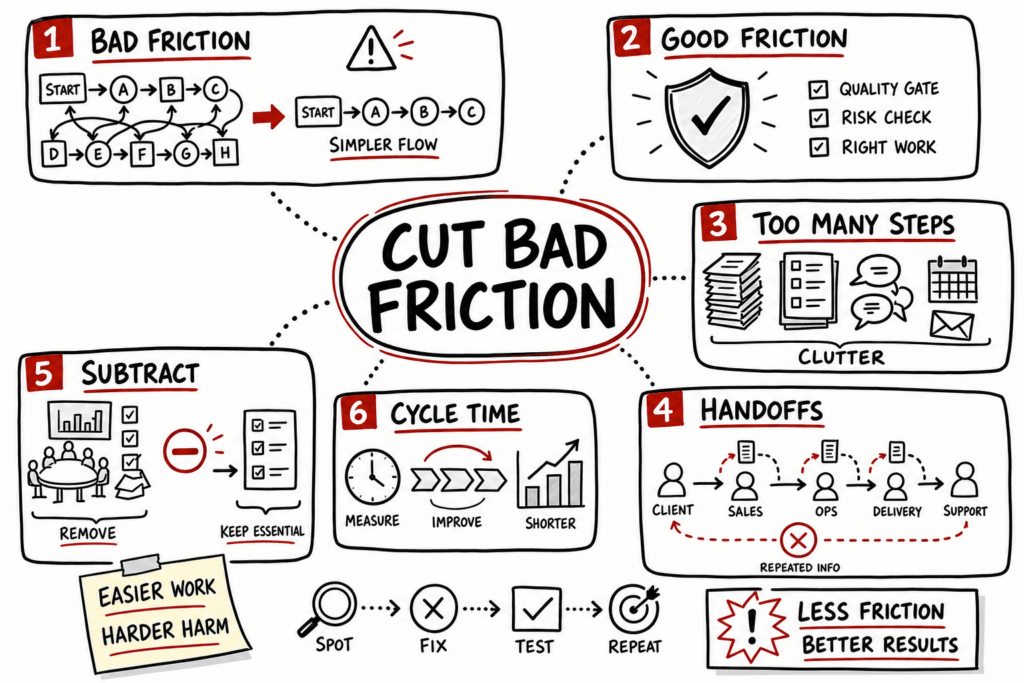
The Friction Project summary for ambitious executives, real estate operators, and operations leaders is this: Robert I. Sutton and Huggy Rao argue that leadership is partly the discipline of making valuable work easier and harmful behavior harder. The strategic implication is not speed for its own sake; it is selective process simplification. The book defines bad friction as unnecessary effort, delay, confusion, or emotional drag that prevents people from doing work that matters. Good friction is deliberate resistance that improves judgment, safety, ethics, or quality. A useful KPI for applying the idea is cycle-time reduction: if a client onboarding workflow takes 12 handoffs, 9 approvals, and 14 days, the leader should ask which steps protect value and which steps merely protect habit. This is an operations leadership book for readers who want better execution without confusing busyness with control.
Who Should Read It
The Friction Project is best for leaders who suspect their organization is quietly taxing its own talent. If your team loses hours to approval chains, redundant reporting, unclear ownership, bloated meetings, clunky software, or client-facing delays, this book will feel familiar in a useful way.
This is not a motivational book about moving faster. It is a business book summary candidate for executives who need a cleaner operating lens. The strongest fit is CEOs, COOs, managing brokers, team leaders, department heads, and real estate operations leadership professionals who sit between strategy and daily execution. These readers are responsible for turning ambition into repeatable systems without smothering judgment.
It is also useful for luxury real estate firms where client experience optimization depends on invisible operational excellence. A wealthy client does not care how complex your back office is. They care whether your team responds cleanly, coordinates intelligently, anticipates problems, and removes stress from the transaction. The book gives language to a problem many premium-service firms feel but fail to diagnose: complexity disguised as professionalism.
Core Idea
The central argument is elegant: great leaders are friction fixers. Sutton and Rao are not telling leaders to eliminate all obstacles. They are asking leaders to become more intentional about where resistance belongs.
Bad friction makes good work harder. It appears as slow decisions, vague processes, duplicate approvals, status meetings with no decision rights, technology that adds steps instead of removing them, and policies created for edge cases but imposed on everyone. Good friction, by contrast, protects the business. It slows down reckless hiring, unethical selling, sloppy financial decisions, brand-damaging shortcuts, and low-quality client communication.
That distinction matters. Many leaders hear the phrase organizational friction and assume the goal is speed. Sutton and Rao are more nuanced. The point is not to become frictionless. Frictionless organizations can become careless, impulsive, or chaotic. The point is to make the right things easier and the wrong things harder.
That makes the book especially relevant to strategy lessons for leaders. Strategy often fails not because the plan is weak, but because the operating environment punishes the behavior the strategy requires. If your strategy depends on proactive client service, but your agents or staff spend hours chasing internal signatures, your system is contradicting your promise.
Best Takeaways
1. Treat friction as a leadership responsibility, not an employee complaint
One of the best leadership lessons from The Friction Project is that friction is not just an annoyance at the front line. It is evidence. When good people repeatedly struggle to complete obvious tasks, leaders should not default to coaching, discipline, or more training. They should inspect the system.
This is where the book connects well with practical operations thinking. The best operators do not romanticize heroic effort. They ask why heroics are necessary in the first place. For broader operational context, the McKinsey operations insights library often reinforces the same principle: performance improvement usually requires redesigning the work, not just demanding more effort from workers.
2. Make subtraction a real management skill
Most organizations are better at adding than subtracting. They add meetings, dashboards, platforms, approval layers, policy documents, and communication channels. They rarely remove with the same seriousness.
The Friction Project review takeaway here is blunt: subtraction is strategy. If a process does not reduce risk, improve quality, increase revenue, protect compliance, or improve client experience, it deserves scrutiny. In real estate, this might mean auditing listing launch workflows, offer communication processes, transaction coordination, marketing approvals, CRM follow-up rules, or client intake forms.
The goal is not to cut corners. The goal is to stop confusing complexity with sophistication. Luxury clients often experience operational bloat as delay, inconsistency, or forced repetition. Process simplification is not an internal housekeeping project; it is a brand protection move.
3. Look for friction in handoffs
Handoffs are where good intentions often become client frustration. A lead moves from marketing to an agent. A listing moves from intake to staging to photography to copywriting to launch. A signed contract moves to transaction coordination, lender communication, inspection management, attorney review, and closing logistics.
Each handoff creates a chance for lost context. The book’s value is that it helps leaders see these moments as friction points, not personality problems. A practical measure is the number of times a client or team member must repeat the same information. If a seller has to restate timeline, access instructions, preferred communication style, or pricing concerns to three different people, the firm has a system issue.
4. Add good friction where standards matter
The book avoids the common trap of worshipping speed. Some things should be harder. It should be harder to publish weak property copy, send sloppy financial estimates, skip disclosure review, onboard a poor-fit hire, or make exceptions that damage trust.
This is particularly important in high-end advisory businesses. In luxury real estate, the cost of a bad shortcut is not only operational. It can become reputational. Good friction might include a pre-launch quality checklist, a second review of pricing strategy, or a required debrief before accepting a complex client engagement. These steps slow the team slightly in order to protect the client and the brand.
Where It Falls Short
The book is useful, but it is not a complete operating manual. Readers looking for plug-and-play templates may find it more diagnostic than prescriptive. Sutton and Rao provide a strong mindset and memorable distinctions, but implementation still depends on the leader’s ability to map workflows, confront sacred cows, and sustain behavioral change.
The other limitation is that friction is easier to spot than to remove. Every unnecessary step has a defender. A report exists because someone once asked for visibility. An approval exists because someone once made a mistake. A meeting exists because no one wants to own the decision asynchronously. The book gives leaders courage to question these artifacts, but it does not remove the political labor.
There is also a risk of overusing the concept. Not every irritation is bad friction. Some team members may label accountability, documentation, compliance, or quality control as friction because it slows them down. Strong leaders will need to separate legitimate operational drag from normal professional discipline.
For readers who want adjacent research on leadership, work design, and organizational behavior, Harvard Business Review is a useful companion source. The best use of Sutton and Rao’s ideas is not to declare war on process. It is to become more precise about which processes earn their cost.
How to Apply It
Start with one client-facing journey, not the whole company. For a real estate firm, choose seller onboarding, buyer consultation, listing launch, offer negotiation, contract-to-close, or post-closing follow-up. Map every step from the client’s point of view and the team’s point of view.
Then ask four questions. First, where does the client wait without understanding why? Second, where does the team duplicate effort? Third, where do approvals improve quality versus simply transfer anxiety upward? Fourth, where should the firm intentionally slow down to protect judgment, compliance, or brand standards?
Next, assign a friction owner. This should be someone with enough authority to remove steps, not merely document complaints. Track one or two metrics before and after changes. Useful examples include days from signed listing agreement to market launch, number of internal handoffs per transaction, percentage of files returned for missing information, response time to client inquiries, or meeting hours per closed deal.
For leadership teams, the strongest habit is a monthly friction review. Keep it short. Ask each department to bring one example of bad friction to remove and one example of good friction to protect or strengthen. This forces leaders to build an operating culture where simplicity and standards coexist.
In a brokerage or advisory business, this can become a competitive advantage. Many firms compete on personality, network, and marketing polish. Fewer compete on operational ease. Yet clients remember how the process felt. They remember whether they had to chase updates, repeat information, interpret confusion, or absorb stress that the firm should have handled.
The most practical mindset shift from the book is this: leaders should stop asking only, How do we get people to work harder? They should also ask, What have we made unnecessarily hard? That question is uncomfortable because the answer often points back to leadership habits, legacy processes, and unexamined control systems. But it is also where the leverage is.
Final Verdict
The Friction Project is a sharp, relevant read for operators who want cleaner execution without flattening the judgment and safeguards that keep a business strong. It is especially valuable for leaders in service businesses where internal complexity leaks directly into the client experience.
The book is not overhyped if you treat it as a lens, not a turnkey system. Its best contribution is giving leaders a practical vocabulary for distinguishing drag from discipline. For real estate operators, that distinction can improve workflows, protect premium service, and make growth feel less chaotic.
If you want more private-briefing style reads on strategy, operations, and leadership for high-performing real estate businesses, explore more RE Luxe Leaders strategy briefings or book a confidential strategy call.