Is This Keith Haring in 3D Review Worth Your Time?
This Keith Haring in 3D review is for affluent founders, executives, collectors, and culture-minded readers who want to understand why Haring’s dimensional work matters beyond brand recognition. Keith Haring in 3D, by Larry Warsh and Glenn Adamson with contributions from Dieter Buchhart, David Galloway, Francis M. Naumann, Lowery Stokes Sims, and Robert Storr, argues that Haring’s move into objects, sculpture, and spatial form was not a side project but a strategic expansion of his visual language. The practical implication: if you evaluate art, culture, or legacy assets, you should look beyond image familiarity and ask how a work changes when it occupies public, physical, and market space. A useful threshold for collectors is simple: if a piece cannot be explained through provenance, medium, condition, edition history, and institutional relevance, admiration is not enough.
Book Overview and Publication Context
Keith Haring in 3D arrives with a clear job: reposition Haring’s three-dimensional output as central to understanding his career, not as decorative overflow from the subway drawings and wall works that made him globally recognizable. The book’s value is partly editorial. Larry Warsh and Glenn Adamson bring collector-facing and design-historical instincts, while the contributor list adds museum, curatorial, and art-historical depth. That combination matters because Haring is often flattened into iconography: radiant babies, barking dogs, dancing figures, thick lines, bright color. This book pushes the reader to see the forms as spatial propositions.
The publication also sits comfortably inside the kind of cultural-literacy reading that wealth advisers increasingly recommend to clients. Its presence around JPMorgan’s broader wealth-reading conversation is unsurprising; JPMorgan has long served clients for whom art is not just taste, but identity, legacy, access, and capital allocation. This is not a pricing manual. It is a framing tool. For readers looking for a Keith Haring in 3D summary, the short version is this: Haring’s dimensional practice makes his work less like a logo and more like a social architecture.
Core Idea
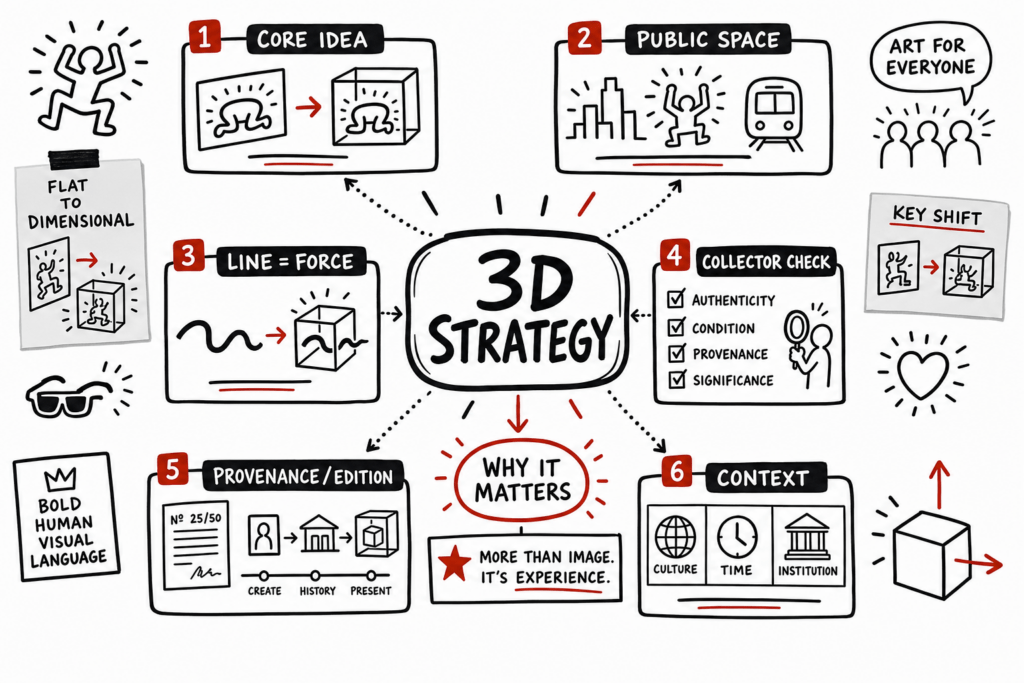
The core argument is that Haring’s jump from flat surfaces into three-dimensional form was inevitable once you understand his obsession with movement, bodies, public attention, and accessible communication. His figures were never static. Even in two dimensions, they behave like they are pushing against the wall, vibrating in a crowd, or trying to cross into the viewer’s space. Sculpture, installation, painted objects, and public works gave those figures a physical arena.
That is the strongest art-historical angle in the book. Haring’s subway drawings were not simply early graffiti-adjacent works; they were interventions in shared space. His later dimensional output extends that same impulse. The point is not that 3D work is automatically more mature. The point is that it makes visible what was already latent in his line: speed, contact, repetition, danger, play, and mass communication. For anyone using this as a Keith Haring art history book, the best reading is to treat it as a bridge between street visibility, post-pop immediacy, public sculpture, and late twentieth-century debates about accessibility.
Keith Haring in 3D Review: Best Takeaways
1. Haring’s line was always spatial
The book is most useful when it helps you stop seeing Haring’s line as a graphic signature and start seeing it as an engine. The energy lines around bodies and animals are not decorative punctuation. They are instructions for how to read force, urgency, sound, and social motion. In three dimensions, that logic becomes harder to ignore. A figure that once looked like it was moving across paper can now occupy a room, a plaza, a surface, or an object.
2. The public dimension is not an afterthought
Haring’s accessibility is often misunderstood as simplicity. The better interpretation is strategic legibility. He created forms that could travel across subway platforms, clubs, murals, merchandise, museums, activism, and private collections without losing their charge. That does not make every use equally strong. But it does explain why the dimensional works resonate with high-net-worth audiences: they combine cultural fluency, recognizability, and physical presence. Those are three different forms of value.
3. Collector insights come from context, not just scarcity
The most useful Keith Haring collector insights here are not market tips. They are context filters. A serious collector should ask: What role does the object play in Haring’s broader visual system? How does it connect to his public-facing practice? Is the three-dimensional form integral, or is it a translation of a more famous image? What is the object’s provenance, exhibition history, condition, and relationship to authenticated bodies of work? The Keith Haring Foundation remains an essential reference point for biographical and contextual grounding.
4. The book sharpens cultural literacy for leaders
There are real Keith Haring leadership lessons here if you read beyond the art-market frame. Haring understood repeatable symbols, public distribution, emotional immediacy, and mission clarity before those ideas became business clichés. He built a language that could be recognized quickly without becoming empty. For executives, that is a strategy lesson: consistency is not the same as sameness. The strongest brands, like the strongest visual systems, can scale across formats while retaining a recognizable pulse.
Who Should Read It
The best Keith Haring in 3D reader fit is someone who already knows the headline version of Haring and wants a more dimensional understanding, literally and strategically. If you are a collector, adviser, founder, family-office principal, curator-adjacent reader, or executive trying to build stronger cultural pattern recognition, this book gives you useful language. It will help you discuss Haring without sounding like you are reciting auction-catalog shorthand.
It is also a strong fit for readers who want to understand how an artist’s market visibility can obscure the complexity of the work. Haring is one of those names everyone thinks they know. That familiarity can be dangerous. It tempts people to confuse recognition with comprehension. This book slows that reflex down.
It is less ideal if you want a full biography, a complete market report, or a beginner’s introduction to the 1980s New York art world. You will get context, but the book is primarily concerned with Haring’s dimensional output and its art-historical implications.
Where It Falls Short
The main limitation is that the book’s strength can also become its blind spot. Because it wants to correct the under-attention given to Haring’s 3D work, it sometimes risks making the dimensional turn feel more singular than messy. In reality, artists move across media for many reasons: curiosity, opportunity, patronage, public commissions, studio momentum, market demand, and formal necessity. The most valuable reading keeps all of those factors in view.
Another caveat: readers seeking hard valuation guidance will not find a collector’s operating manual. That is not really the book’s purpose. It gives you interpretive intelligence, not acquisition rules. For serious collecting, you still need provenance review, condition assessment, edition verification where relevant, legal diligence, and an adviser who is not financially incentivized to tell you every object is important.
The book also leans toward readers who are already comfortable with art-world discourse. It is clear enough, but not always introductory. If you are new to Haring, pair it with a basic timeline of his career before expecting the deeper arguments to fully land.
How to Apply It
For collectors
Use the book as a due-diligence lens. Before pursuing a dimensional Haring-related work or adjacent object, create a one-page acquisition memo. Include five fields: medium and fabrication details, provenance, exhibition or publication history, condition and conservation concerns, and relevance to Haring’s broader practice. If you cannot make a coherent case in those five areas, pause. Desire is not diligence.
For founders and executives
The best Keith Haring strategy lessons are about language, scale, and access. Haring’s symbols worked because they were instantly legible but not emotionally thin. Leaders can borrow the principle without copying the aesthetics: define the few signals your organization repeats across products, rooms, investor conversations, recruiting, and public presence. If those signals change every quarter, you do not have a strategy; you have campaigns.
For culture-minded readers
Use the book to refine how you look. When you encounter Haring’s work, ask what the surface is doing, what the body is doing, what the viewer is asked to do, and how publicness changes the meaning. That simple framework turns a familiar image into an active encounter. It also gives you better conversation fluency at fairs, museum events, private dinners, and board-level cultural discussions.
For advisers and wealth teams
This book can support client education around art as legacy, not just asset class. The cleanest business application is a cultural-intelligence briefing: choose one artist, one medium shift, one market misconception, and one diligence checklist. Haring’s 3D artwork context is an ideal case because it sits at the intersection of fame, public life, activism, design, sculpture, and collecting.
Final Verdict
This Keith Haring in 3D book review comes down to one judgment: the book is worth reading if you want to move from image recognition to informed interpretation. It makes a persuasive case that Haring’s three-dimensional works deserve more serious attention, especially from collectors and leaders who care about how culture moves through space, institutions, markets, and memory.
It is not a magic key to valuation, and it should not be treated as acquisition advice. Its value is sharper than that. It helps you see why dimensional form changes the stakes of Haring’s practice and why public accessibility was not a compromise in his work, but a core strategic force.
For more briefings like this, read the latest RE Luxe Leaders strategy reviews, or book a confidential strategy call if you want sharper cultural, brand, and positioning intelligence around collecting, leadership, and legacy.