
Same as Ever Key Takeaways for Leaders Navigating Change
What Are the Same as Ever Key Takeaways?
Same as Ever is most useful for leaders who make decisions under uncertainty and want to distinguish durable human behavior from changing conditions. Morgan Housel’s central lens is that incentives, fear, status, stories and patience continue to shape choices even as technology, markets and institutions change.
That lens is practical for a real estate leader. Financing, inventory, policy and buyer sentiment move; trust, ambition, loss aversion and the need for a coherent story remain familiar. The book is a set of mental models, not a forecasting system or operating manual.
Book Overview
Housel writes in short, essay-like chapters about what tends not to change. The appeal is accessibility: the reader can carry a question from one chapter into a leadership meeting, investment discussion or client conversation. The tradeoff is that the book does not supply a complete research apparatus or a step-by-step implementation plan.
Its strongest use is as a prompt to separate constants from variables. A new technology may alter speed, distribution or cost, but it does not erase incentives, uncertainty or the social meaning people attach to decisions. A leader can use that distinction without treating every historical analogy as a prediction.
Who Should Read It
The book fits founders, investors, developers, brokerage leaders, family office principals and operators who must choose with incomplete information. It is less suitable for readers seeking a tactical checklist, a technical forecast or a dense footnote trail.
Real estate leaders may recognize recurring patterns in changing markets: optimism stretches risk, calm periods soften diligence, and recent winners become templates for the next decision. Those observations are useful when they sharpen a question about the current facts; they should not replace current underwriting, legal advice or market evidence.
Core Idea
The core idea is simple: the future is hard to know, while human behavior is often more consistent than the surrounding headlines. Housel’s argument encourages leaders to study permanent incentives and emotions alongside changing technology or policy.
For a team, that means asking whether the compensation plan rewards the behavior the brand promises, whether a new tool changes a process or merely speeds up an old one, and whether a strategy survives more than one financing or demand scenario. These are questions to investigate, not conclusions to assume.
Best Takeaways
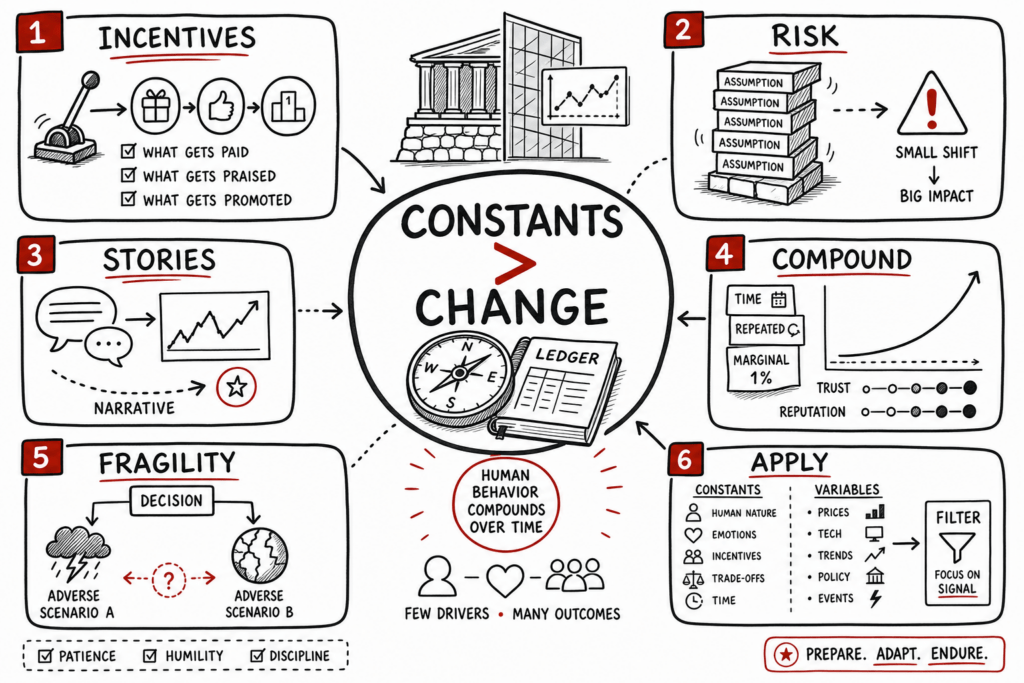
1. Incentives Explain More Than Intentions
When stated values and rewarded behavior diverge, the scoreboard usually wins. Ask what gets paid, praised, promoted and ignored. In a sales organization, a volume-only measure can pull behavior away from a white-glove promise. In a development business, acquisition rewards without downside measures can increase activity without improving judgment.
2. Risk Is Most Dangerous When It Feels Absent
Long stability can make a favorable condition feel permanent. A deal that works only if financing stays cheap, demand stays strong and the exit remains liquid has a fragile base. Build a downside conversation while the numbers still look comfortable, and name which assumption would change the decision first.
3. Stories Move Faster Than Facts
People interpret information through a story about what it means. That does not make narrative a substitute for evidence. It means a strategy should be explainable: what is changing, what is stable, what the team is choosing and what risk it accepts. Clear language helps investors, clients and employees engage with the underlying facts.
4. Compounding Is Boring Before It Is Obvious
Trust, reputation, skill and clean follow-through grow through repeated actions. So do small operational weaknesses. A leader can ask which routine deserves another quarter of disciplined improvement before adding a new initiative.
Where It Falls Short
The book’s compact observations sometimes leave the reader to build the operating method. Its language about timeless behavior can also tempt readers to overgeneralize. Some technologies, regulations and business models do create structural breaks. Use the book to frame questions, then test those questions against current evidence and the particulars of the decision.
How to Apply It
Run a Constants-Versus-Variables Review
For a major decision, create two columns. Put current rates, inventory, technology, policy and buyer mix in the variable column. Put human incentives, trust, accountability, loss aversion and the need for a usable story in the constants column. Then identify where the decision depends on a variable that may change.
Build a Fragility Test Into Major Decisions
List the assumptions that carry the decision and test a modest change in each one. The goal is not to predict every outcome. It is to show the team which assumption deserves a second review, a contingency or a stop rule.
Audit Incentives Before Blaming Culture
When behavior disappoints, compare the stated standard with the way work is assigned, evaluated and rewarded. A clear role, a visible owner and a reasonable measure can fix a problem that a culture speech will not.
Use Story as a Leadership Asset
Explain a decision with the facts, the tradeoff, the next review point and the reason the choice fits the current goal. A useful story makes accountability easier because people know what was chosen and what would cause a change.
Final Verdict
Same as Ever earns a place on the shelf for leaders who want durable questions about incentives, risk, narrative and compounding. It will not provide a market call or substitute for the evidence needed for a specific property, investment or operating decision. Read it as a lens, then do the current work the lens points toward.
You can request a complimentary one-hour conversation with a senior advisor who is an experienced operator. Talk through your next move