What is the Scaling People summary for leaders?
This Scaling People summary is for founders, operators, real-estate team leaders, and service-business executives deciding how to grow a team without letting quality, accountability, or culture drift. In Scaling People, Claire Hughes Johnson argues that scaling is not mainly about hiring more people; it is about installing management systems that make expectations, decisions, feedback, and ownership visible. The strategic implication is clear: if your team is moving beyond roughly 10 to 30 people, informal leadership stops being enough. You need structured role definitions, consistent interviews, onboarding plans, operating cadences, and performance loops.
The book is best treated as a tactical management manual, not a motivational leadership book. Its strongest value is in repeatable tools: hiring and onboarding frameworks, feedback and performance management routines, and organizational design for growth. Leaders who want cleaner execution will find more here than leaders looking for vision-setting inspiration.
Book Overview and Author Background
Scaling People by Claire Hughes Johnson comes from someone who has operated inside serious growth environments. Johnson spent years at Google, then became COO of Stripe, where she helped build operating discipline inside one of the most closely watched technology companies of the past decade. That matters because this is not a theory-heavy book about leadership temperament. It is a field manual for making management less dependent on charisma.
You can see the book’s Stripe DNA immediately: documents, systems, clarity, calibration, written expectations, decision hygiene. The official Stripe Press page for Scaling People positions it as a tactical guide, and that is the right expectation. This is not a cozy read. It is a set of operating instructions.
For RE Luxe Leaders, the relevance is obvious. Real-estate and service businesses often scale through high performers first: the rainmaker agent, the founder, the senior operations lead, the trusted assistant who knows where everything lives. That works until it does not. The first real breaking point usually appears when the founder can no longer personally inspect every client handoff, listing launch, vendor issue, recruiting decision, or performance concern. Johnson’s answer is not to work harder. It is to codify the work.
Who Should Read It
This is a strong book review for leaders who are already feeling the pressure of complexity. If you are asking how to scale a team while keeping standards high, this book belongs on your desk, not your nightstand. It is especially useful for founders, COOs, team leaders, brokerage operators, and department heads who manage through other managers.
The ideal reader has at least a small leadership layer in place or is about to build one. If your business is still two people and every decision runs through you, some of the material may feel early. If you are at 15, 30, 75, or 150 people and your operating rhythm is held together by Slack, memory, and heroic follow-up, the book will feel uncomfortably relevant.
It is also a good reader fit for business leaders who want a common management language across a leadership team. The book gives you vocabulary for role clarity, feedback, hiring bars, management expectations, decision rights, and org design. That shared language is often more valuable than any one template.
Core Idea
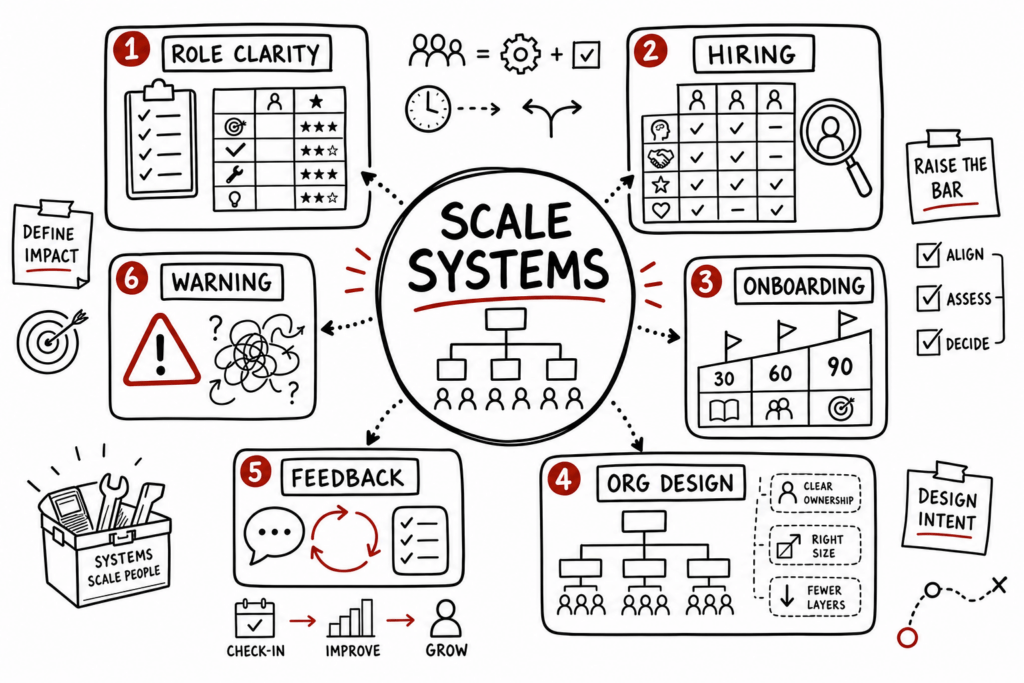
The core idea of this Claire Hughes Johnson book summary is simple: people scale when systems scale. Johnson does not argue that systems replace judgment. She argues that systems protect judgment from chaos. A founder can make good calls one-on-one. A company needs good calls made repeatedly by many people who understand the same standards.
That means management becomes a product. You define the user: the employee, the manager, the candidate, the executive team. You define the desired experience: clarity, speed, fairness, accountability. Then you build mechanisms that make that experience repeatable.
For a real-estate team, that might mean a written role scorecard for a listing coordinator, a 30-60-90 day onboarding plan for a buyer agent, weekly pipeline review standards, a rubric for evaluating client communication, and a clear escalation path when a transaction goes sideways. None of this is glamorous. That is why it works.
The deeper Scaling People leadership lessons are not about becoming more polished. They are about becoming more explicit. Johnson consistently pushes leaders to stop assuming that people understand context, priorities, decision boundaries, or performance expectations. If it matters, write it down. If it affects compensation, promotion, client experience, or trust, calibrate it.
Best Takeaways
1. Define the role before you recruit
One of the strongest Scaling People key takeaways is that hiring problems often begin before the first interview. Leaders rush to recruit because they feel pain: too many leads, too many files, too many meetings, too many client requests. But pain is not a job description.
Johnson pushes for clarity before hiring: What problem is this role solving? What outcomes should the person own? What behaviors matter? What tradeoffs are acceptable? In a brokerage or luxury service business, this prevents the classic vague hire: someone brought in to help with everything who later disappoints everyone because success was never defined.
A practical application: before opening a role, write a one-page scorecard with five sections: mission, top three outcomes, required skills, non-negotiable behaviors, and first 90-day milestones. If you cannot fill that out, you are not ready to interview.
2. Make interviewing consistent, not theatrical
The book’s hiring and onboarding frameworks are useful because they reduce personality-driven hiring. Johnson favors structured interviews, clear evaluation criteria, and decision discipline. That matters in service businesses where charismatic candidates can easily outperform in conversation and underperform in execution.
For real-estate teams, this means separating warmth from competence. A candidate can be likable and still poor at follow-through. A candidate can speak beautifully about client care and still lack operational detail. Structured questions, work samples, and interviewer calibration protect the business from hiring the best performer in the room rather than the best fit for the role.
3. Onboarding is a management system, not a welcome packet
Johnson treats onboarding as an acceleration process. That is the right lens. A new hire should not spend the first month decoding who matters, where information lives, how decisions get made, and what good looks like.
A strong onboarding sequence should answer four questions fast: What is expected of me? How do I win here? Who do I go to for what? How will my performance be judged? For a growing real-estate operation, a 30-60-90 plan can include CRM standards, client communication scripts, transaction workflow training, shadowing, market knowledge, and first measurable ownership. The KPI is time-to-productivity: how quickly the person can carry meaningful work without creating rework for the team.
4. Feedback should be clear enough to change behavior
The book’s guidance on feedback and performance management is one of its most practical sections. Johnson is direct about the cost of vague feedback. Saying someone needs to be more strategic, more proactive, or more senior is usually not helpful unless the manager defines the behavior behind the label.
The useful tactic is to anchor feedback in observed behavior, business impact, and the specific change required. For example: not, You need better ownership. Better: When inspection objections were delayed by two days, the client lost confidence and the closing timeline tightened. Going forward, escalate risk within 24 hours and confirm next steps in writing.
That kind of feedback is not cruel. It is respectful. It gives the person a fair chance to improve.
5. Org design is a living operating decision
Johnson’s material on organizational design for growth is especially useful for leaders moving from founder-led execution to management-led execution. Org charts are not status maps. They are systems for decision-making, communication, and accountability.
Common scaling bottlenecks appear when too many people report to one strong operator, when roles overlap without clear ownership, or when client experience depends on informal heroics. In operations-heavy businesses, span of control matters. A manager with 12 direct reports in a high-touch environment may technically be managing, but in practice they are probably reacting.
The practical question is not, Who deserves a bigger title? It is, What structure gives the business the best chance of consistent execution?
Where It Falls Short
This Scaling People book review would be incomplete without the caveats. First, the book can feel overbuilt for small businesses. Some tools come from environments with deep talent benches, high documentation norms, and the resources to run structured people processes. A seven-person boutique brokerage does not need every mechanism at full strength.
Second, the book leans heavily toward rational operating systems. That is its strength, but also its limitation. In relationship-driven businesses, emotional trust, local nuance, client psychology, and founder reputation carry real weight. A framework can clarify the handoff, but it cannot replace taste, empathy, or judgment.
Third, some leaders may mistake documentation for leadership. The book gives you templates and systems, but a written expectation is only useful if managers have the courage to enforce it. A performance review process will not fix avoidance. A hiring rubric will not fix weak standards. An org chart will not fix a leader who keeps overriding the structure.
So the warning is this: do not implement the book as bureaucracy. Use it as scaffolding. Keep what sharpens decisions. Drop what slows the business without improving quality.
How to Apply It
The best way to use the book is not to read it once and admire the rigor. Use it as a diagnostic. Pick the area where growth is currently creating the most pain: hiring, onboarding, feedback, management cadence, or org structure. Then install one system at a time.
For hiring
Before your next hire, create a role scorecard. Define the business outcome first, then the tasks. For example, a director of operations is not hired to be organized. They are hired to reduce founder involvement in day-to-day execution, improve client handoff consistency, and create visibility across active transactions. That is measurable.
For onboarding
Build a 30-60-90 day plan for every recurring role. Include systems training, shadowing, client standards, decision rights, and early wins. In a field-based or distributed team, record short Loom-style walkthroughs for recurring processes so training does not depend on who happens to be available.
For feedback
Adopt a simple feedback structure: behavior, impact, expectation. Use it weekly, not only during formal reviews. This is one of the strongest Scaling People management tactics because it reduces surprise. People should not discover how they are perceived only when compensation or promotion is on the line.
For org design
Review your structure every six months during growth periods. Look for overloaded managers, duplicated decisions, unclear handoffs, and founder bottlenecks. If every difficult client issue, pricing exception, recruiting decision, and vendor problem still routes to the founder, the org chart is fiction.
For leadership team alignment
Have each leader read the same selected chapters, then compare where your business is under-systemized. Do not debate philosophy first. List the recurring failures: missed follow-up, inconsistent candidate quality, unclear promotions, client communication gaps, slow decisions. Then map each failure to a process Johnson would make explicit.
If you want the book, you can find it through Amazon’s listing for Scaling People. My recommendation: buy it as a working manual and mark the sections you can turn into operating tools within 30 days.
Final Verdict
Scaling People is most valuable when your business has outgrown personality-based management. It will not make leadership easy, and it will not remove the human messiness of growth. But it will give serious operators a cleaner way to hire, onboard, coach, structure, and scale.
For luxury real-estate teams and service businesses, the right move is selective adoption. Do not copy Stripe. Translate the discipline. Use the book to build clearer roles, faster onboarding, better feedback loops, and fewer founder-dependent decisions.
If you want more sharp strategy briefings like this, keep reading RE Luxe Leaders. If your team is scaling and the operating model is starting to strain, book a confidential strategy call and pressure-test the next layer before the business forces the issue.