Is Slow Productivity Worth Reading? A Slow Productivity Review for Leaders
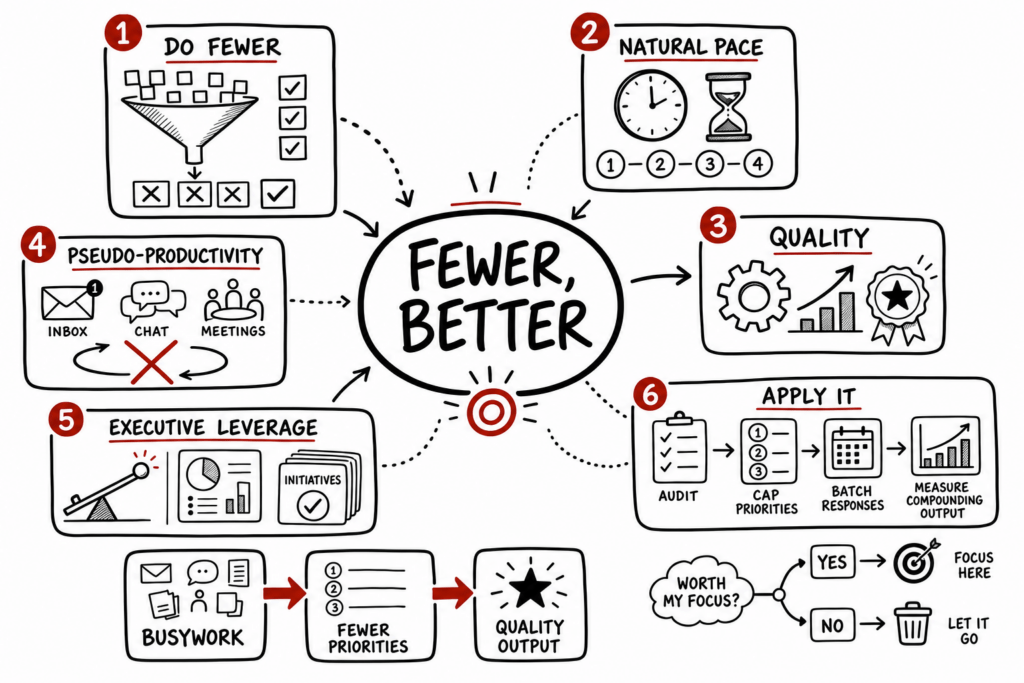
This Slow Productivity review is for brokerage owners, real-estate executives, and ambitious operators deciding whether Cal Newport’s Slow Productivity offers a sustainable operating model: it argues that leaders should do fewer things, work at a natural pace, and obsess over quality so output compounds without burnout. Newport defines “slow productivity” as a philosophy for knowledge work built around three rules: do fewer things, work at a natural pace, and obsess over quality. The strategic implication is clear: stop measuring leadership by message volume, meeting density, or visible busyness, and start measuring leverage through completed decisions, shipped initiatives, client experience gains, and team capacity preserved. For a brokerage leader, one practical KPI is the number of high-value initiatives finished per quarter without increasing after-hours work. If your current system rewards constant responsiveness, this book is a useful reset; if you need tactical calendar templates, it is more philosophy than playbook.
Slow Productivity Review: Book Overview and Context
Cal Newport has been circling this argument for years. Deep Work made the case that focused cognitive effort is becoming rare and valuable. Slow Productivity expands that idea into a broader work philosophy for professionals drowning in open loops, Slack pings, client demands, internal approvals, and the quiet pressure to appear constantly available.
The official publisher page for Cal Newport’s Slow Productivity positions the book as a response to pseudo-productivity: the modern habit of using visible activity as a proxy for meaningful accomplishment. That framing matters for leaders. In real estate, for example, a brokerage owner can look “productive” all day by answering agent questions, reviewing deal problems, attending vendor calls, and checking dashboards. But none of that guarantees stronger recruiting, better retention, cleaner operations, or a more defensible market position.
This is why the book has traction with operators looking for business productivity strategies that do not depend on white-knuckling. Newport is not telling high performers to become casual. He is arguing that sustainable excellence requires a different scoreboard.
Who Should Read It
Slow Productivity is a strong fit for leaders whose work has become too fragmented to produce meaningful strategic progress. That includes brokerage owners, team leaders, real-estate executives, founders, senior operators, consultants, and anyone responsible for both execution and judgment.
This is especially relevant if your calendar is full but your business priorities keep slipping. If your team expects instant answers, if every initiative becomes a meeting series, or if your best thinking happens after 8 p.m. because the workday is too noisy, Newport’s argument will feel uncomfortably familiar.
It is also a useful productivity book for leaders who have outgrown basic time management advice. This is not about color-coding your calendar or finding the perfect task app. The book is about choosing fewer commitments, sequencing work intelligently, and protecting the quality of your decision-making.
For readers specifically looking for a book review for real estate leaders, the practical fit is clear: real-estate leadership is reactive by default. Markets move, clients panic, deals break, agents need support, and recruiting never stops. Newport’s framework helps separate true leadership work from ambient operational noise.
Core Idea
The core idea is simple and hard to practice: knowledge workers should stop treating busyness as productivity. Newport argues that the industrial-age model of visible output does not translate cleanly to modern cognitive work. If the work is thinking, deciding, building, designing, coaching, negotiating, or writing, then speed and volume are not the only measures that matter.
His three-part framework is the heart of the book: do fewer things, work at a natural pace, and obsess over quality. As a Slow Productivity summary, that may sound almost too clean. But the value is in the pressure it puts on your current operating system. If you are committed to twelve major initiatives, available on demand, and evaluating yourself by inbox responsiveness, you are not leading from leverage. You are managing overload.
The strongest leadership lessons from Slow Productivity are not anti-ambition. Newport is not romanticizing idleness. He is asking leaders to take accomplishment seriously enough to stop diluting it with low-value motion.
Best Takeaways
1. Fewer priorities create more executive force
The most useful idea for executives is constraint. Newport’s “do fewer things” principle translates well into quarterly leadership planning. A brokerage owner might cap the business at three strategic initiatives per quarter: recruiting pipeline, agent productivity system, and luxury listing presentation upgrade. Everything else is maintenance, delegation, or later.
This gives you a practical KPI: completed strategic initiatives per quarter. Not meetings held. Not messages answered. Not “projects in progress.” Completed, adopted, measurable improvements.
2. Natural pace beats crisis pace
Newport’s argument about pace is especially relevant for how to avoid burnout in business. Many leaders confuse urgency with importance because urgency is emotionally louder. But a company run entirely on urgency eventually trains everyone to stop planning.
A natural pace does not mean slow execution. It means matching work intensity to the type of work. Negotiating a major acquisition, rebuilding a compensation model, or repositioning a brokerage brand requires deeper cycles than routine approvals. The leader’s job is to protect the cycles that matter.
3. Quality is a productivity multiplier
Newport’s third principle, obsess over quality, is the most commercially useful. In a luxury real-estate environment, quality is not decoration. It is margin protection. Better listing strategy, sharper client communication, stronger agent standards, cleaner operational playbooks, and more thoughtful recruiting all compound.
This is where Cal Newport Slow Productivity thinking connects with executive leverage. One excellent decision can remove dozens of future problems. One strong operating standard can reduce hundreds of repetitive questions. One well-built training asset can lift an entire team.
4. Pseudo-productivity is a leadership trap
The book is at its best when naming the false comfort of busyness. Leaders often use activity to soothe uncertainty. If the market is soft, answer more emails. If recruiting is weak, schedule more check-ins. If the team is unfocused, hold another meeting. Some of that may be necessary. Much of it is noise.
A better question is: what work would make the next six months easier, clearer, or more profitable? That is the shift from reactive labor to executive productivity.
Where It Falls Short
The main limitation: Slow Productivity is stronger as a philosophy than as an implementation manual. If you want a detailed productivity framework for executives with templates, dashboards, and meeting cadences, you will need to build those yourself.
Newport gives principles and examples, but leaders operating complex businesses may want more direct guidance on delegation, team communication, and organizational resistance. The book is persuasive about why pseudo-productivity fails. It is less granular on how to unwind it when your clients, agents, partners, and staff have been trained to expect instant access.
There is also a privilege issue worth naming. Some professionals have more control over workload than others. A CEO, owner, or senior executive can redesign commitments more easily than a junior employee. That does not make the book irrelevant, but it does mean leaders have a responsibility to apply it systemically, not just personally. If the owner adopts slow productivity while the team remains buried in chaos, the philosophy has not really landed.
For more context on Newport’s broader body of work, his official site at CalNewport.com is useful. It shows how this book fits into his long-running critique of attention fragmentation and modern work culture.
How to Apply It
Run a commitment audit
List every active initiative, recurring meeting, reporting obligation, and informal promise currently pulling on your attention. Then mark each as revenue-critical, risk-critical, relationship-critical, or optional. Most leaders discover they are carrying too many “important-sounding” obligations that do not deserve executive attention.
Cap strategic work
Choose no more than three strategic priorities for the next quarter. For a brokerage, that might mean improving agent retention, increasing luxury listing conversion, and documenting the transaction escalation process. If a new idea emerges, it enters the queue instead of hijacking the week.
Redesign responsiveness rules
Slow productivity fails if everyone still expects immediate access. Set communication tiers. True emergencies get calls. Same-day operational issues go to a designated channel. Strategic questions are batched. This protects leadership bandwidth without abandoning the team.
Measure output that compounds
Replace vanity productivity metrics with leverage metrics. Examples: number of recurring issues eliminated, percentage of meetings removed, agent onboarding time reduced, client response quality improved, recruiting follow-up cycle completed, or after-hours work reduced without service decline.
Create quality standards
Pick one high-value area and raise the standard. Your listing launch process. Your agent coaching rhythm. Your seller consultation. Your referral partner follow-up. Newport’s quality principle becomes practical when it is attached to a repeatable business asset.
Final Verdict
Slow Productivity is worth reading if you are a high-performing leader who feels productive in the moment but underwhelmed by what actually gets finished. The book will not run your calendar for you. It will not solve every operational constraint. But it gives language to a problem many executives quietly know they have: the business is consuming attention faster than leadership can convert it into durable progress.
The best use of this book is not inspiration. It is diagnosis. Read it, then audit your commitments, reset your quarterly priorities, and decide what kind of output truly deserves your best energy.
For RE Luxe Leaders readers, the takeaway is blunt: luxury leadership requires capacity. If your operating model leaves no room for judgment, creativity, or high-quality decision-making, it is not a productivity system. It is a burnout machine with a calendar invite.
If you want more sharp strategy briefings like this Slow Productivity book review, explore the RE Luxe Leaders library—or book a confidential strategy call to pressure-test how your leadership operating system is really performing.