
Superagency Summary: Practical AI Strategy for Leaders
What is the best Superagency summary for business leaders?
Superagency by Reid Hoffman and Greg Beato argues that technology can expand human agency when leaders shape the surrounding workflows, incentives and decision rights. For a real estate or luxury-services operator, the useful question is not how many tools the firm has. It is whether people can make better decisions, serve clients more clearly and learn faster while responsibility remains visible.
This review treats the book as a strategic posture, not an implementation manual or a promise of automatic productivity. The official Superagency site provides additional author and book context.
Book Overview and Context
Hoffman, a technology investor and LinkedIn co-founder, and journalist Greg Beato place AI in a wider argument about human capacity and institutional choices. The book resists both passive acceptance and panic. It asks leaders to participate in shaping the systems through which AI is adopted.
That makes the book relevant to founders and operators rather than only technical teams. AI can support research, briefing, document preparation or pattern recognition, but a luxury client still pays for judgment, discretion, interpretation and confidence. A chatbot is not a client-experience strategy. A data room is not portfolio intelligence. Human leaders have to define what good work means and where the tool may assist.
Additional public background on Hoffman is available through his author profile; it is context, not evidence of a particular business result.
Who Should Read It
The best fit is a leader who believes AI matters but has not decided where it belongs. A real estate, advisory, investment, hospitality or client-service firm can use the book to discuss scattered experimentation, risk paralysis or vendor dependence without reducing the question to software procurement.
It will not teach a complete prompt library, vendor-selection process or technical architecture. It can help a leadership team state why a workflow should change, what human judgment must remain and how a contained experiment should be reviewed.
Core Idea
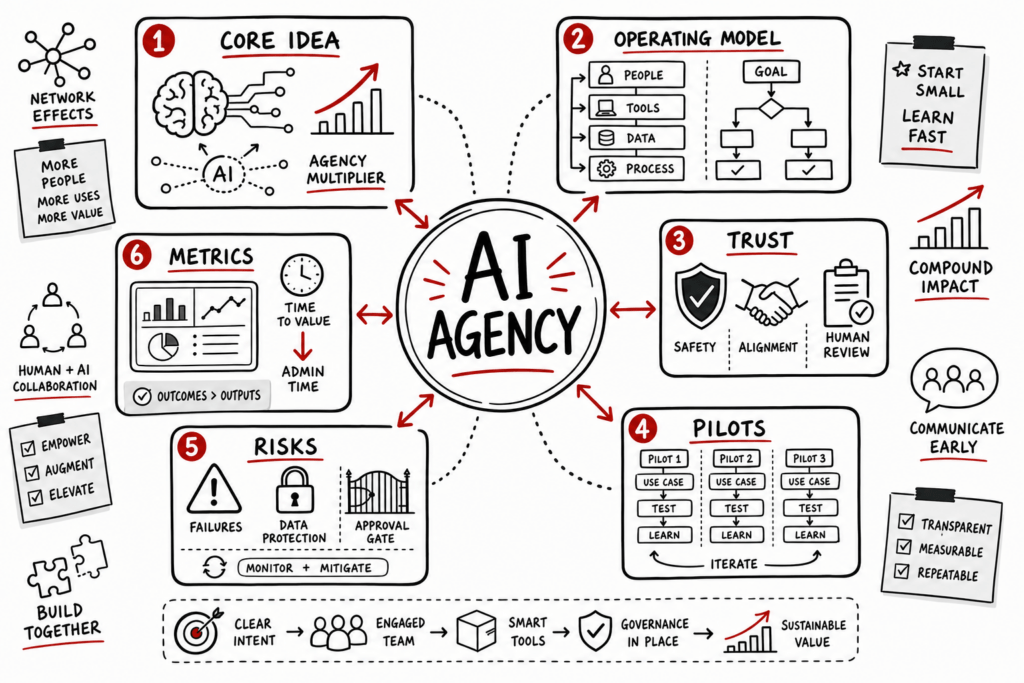
The central idea is that AI should increase a person’s ability to act with better information and broader reach. That makes AI strategy an operating-model decision. If the tool lives only inside a subscription, the firm may gain isolated convenience. If it is integrated into how knowledge is captured, decisions are reviewed and clients are served, the firm can learn where augmentation is worth the risk.
Agency is the test. Does the workflow help the team choose, explain, create or serve more responsibly? If it merely generates more output, it may be impressive without being strategically useful.
Best Takeaways
1. Agency is the leadership metric that matters
Evaluate a workflow by the useful action it enables. Does it reduce low-value coordination, reveal an option, improve a briefing or help a person make a clearer call? If the answer is unclear, the project needs a better purpose before it needs another tool.
2. Optimism can be operational, not sentimental
The book’s optimism is most useful when converted into bounded experiments. Choose a use case, define the baseline, name an owner, set a review date and record what failed as well as what helped. The threshold should fit the workflow; no universal percentage proves that an AI pilot is valuable.
3. AI strategy for founders must include client trust
Any workflow touching client communication, valuation, negotiation preparation, financial assumptions or private data needs visible human accountability. Define what information may enter the system, what must be reviewed, how errors are corrected and who can stop the process.
4. The winning teams will learn faster
Early, contained use can show where data is weak, where tools fail and where clients value a faster or clearer response. Learning speed is useful only when the team keeps a record of the decision, the risk and the evidence instead of treating adoption as a virtue by itself.
Where It Falls Short
The book can understate the hard middle layer: fragmented data, training, change management, vendor incentives, privacy, bias checks, source verification and risk ownership. Its optimism gives leaders permission to move, but it does not supply an AI operating manual.
Read it for posture and language. Add the firm’s own policy for human review, client consent, confidential data, brand voice, escalation and records before a workflow touches real work.
How to Apply It
Start with an agency audit
List the decisions or workflows where the team loses time, judgment or client confidence. In a real estate firm that may include research, listing preparation, buyer matching, due diligence, CRM follow-up, content production or client briefings. Ask where better synthesis would create more human leverage.
Separate automation from augmentation
Automation removes a task; augmentation improves a person’s ability to perform it. Start with the second question: where can capable people make better calls with better support? This keeps the strategy focused on quality and accountability rather than replacing judgment for its own sake.
Create three pilot lanes
Separate internal productivity, client experience and strategic intelligence. A pilot might summarize a meeting, prepare a research brief or organize a review packet. Give it an owner, a risk rating, a baseline and a date for deciding whether to continue, change or stop.
Set non-negotiables
Require human approval for pricing guidance, negotiation language, legal interpretation, financial assumptions, confidential client details and public brand statements. Define the approved data path and the record that shows who reviewed the output.
Turn the book into a leadership conversation
Ask the senior team: if AI expanded our agency this year, what would a client actually notice? The answer should describe clearer recommendations, more useful response, stronger execution or better learning—not a bigger tool list.
Final Verdict
Superagency gives business leaders a constructive frame for human-directed AI. Its best contribution is language for agency, experimentation, trust and organizational learning. Its limitation is implementation depth. Pair the optimism with evidence, ownership and review before allowing a tool to shape client work or private information.
You can request a complimentary one-hour conversation with a senior advisor who is an experienced operator. Talk through your next move when your firm needs to turn AI enthusiasm into a bounded, human-owned operating experiment.