What are The Anxious Generation book review and takeaways for leaders?
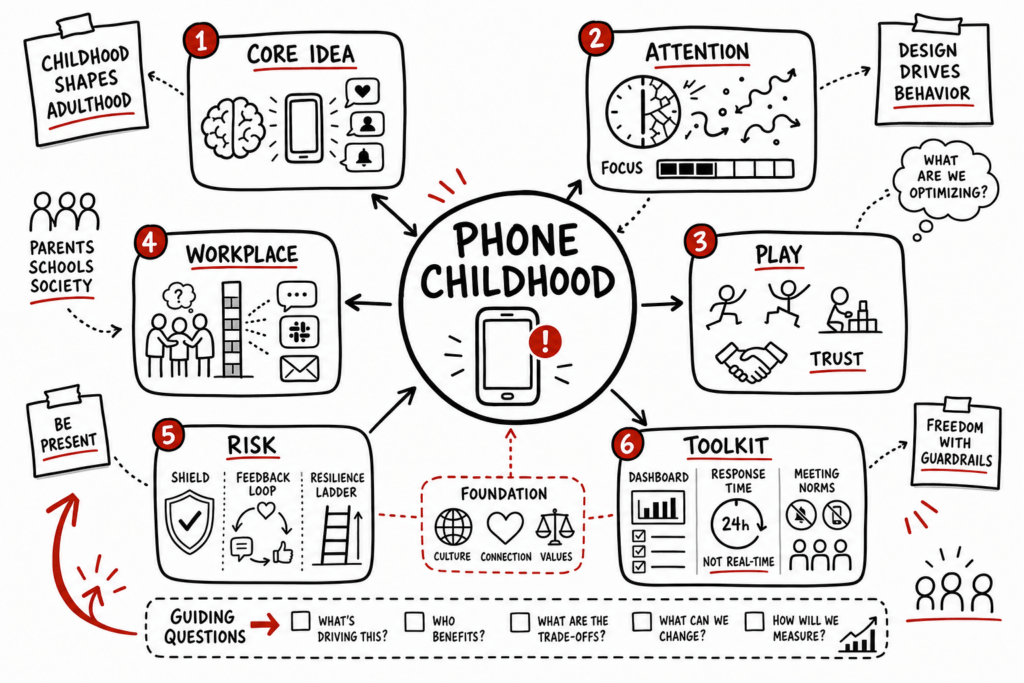
The Anxious Generation book review and takeaways for executives are clear: Jonathan Haidt argues that phone-based childhood changed Gen Z’s attention, social development, and mental health, and leaders should treat this as a workforce-design issue, not just a parenting debate. The book’s strategic implication is practical: younger employees may enter work with lower tolerance for ambiguity, heavier digital dependence, and fewer repetitions in conflict, independence, and in-person trust-building. A useful business KPI is not “screen time” alone, but measurable collaboration health: response-time expectations, meeting quality, psychological safety scores, retention among early-career hires, and manager time spent on emotional escalation. Reader fit: if you lead teams, hire Gen Z talent, or shape culture, this is worth reading. If you want airtight causation rather than a strong synthesis of trend data and argument, read it with a critical margin.
Book Overview
The Anxious Generation by Jonathan Haidt is not a conventional parenting book, although parents are one of its obvious audiences. It is a social diagnosis of what Haidt calls the “great rewiring of childhood,” his shorthand for the rapid shift from play-based childhood to phone-based childhood. For leaders, that phrase matters because childhood is now showing up in the workplace as attention patterns, risk tolerance, social confidence, and expectations around safety.
This Jonathan Haidt The Anxious Generation review is written as a book review for executives, not as a culture-war verdict. Haidt’s case is that the mental health decline among adolescents, especially after the early 2010s, tracks closely with the arrival of smartphones, front-facing cameras, app-based social comparison, and always-on peer evaluation. He also argues that children lost unstructured play, physical independence, and real-world social practice at the same time. The combination is the real thesis: too much digital exposure, too little embodied development.
For background on Haidt’s broader work and public research notes, see Jonathan Haidt’s official site. For broader data on teens, technology, and online life, Pew Research Center is a useful companion source.
The Anxious Generation book review and takeaways: Core Idea
The core idea is simple and uncomfortable: the smartphone became a social environment, not a tool. Haidt argues that adults treated it like a private device while children experienced it as a portable status market, entertainment feed, surveillance layer, and social sorting machine. That distinction is the key to The Anxious Generation summary. The concern is not just that kids spent too much time online. It is that formative years were reorganized around interruption, comparison, performance, and reduced unsupervised in-person interaction.
The strongest part of the book is Haidt’s synthesis. He pulls together mental health trends, platform dynamics, developmental psychology, and social norms. He is especially persuasive when he shows how individual families and schools are trapped in coordination problems. One parent cannot easily say no to a phone if every other child has one. One school cannot fully change norms if parents expect constant access. One employee cannot protect deep work if the whole company runs on instant-response habits.
That is where the workplace implications of The Anxious Generation become relevant. Leaders face the same coordination problem. Most companies say they value focus, resilience, and collaboration, while designing communication systems that reward speed, visibility, and performative availability. Haidt’s argument gives executives a sharper lens for asking: are we managing adults, or are we unknowingly extending the same attention economy that shaped them?
Who Should Read It
Read it if you lead people under 35. The book is especially useful for CEOs, founders, CHROs, talent leaders, school leaders, and managers of early-career teams. It will help you understand why some younger professionals may be technically capable but less practiced in face-to-face disagreement, independent problem solving, boredom tolerance, or slow trust-building.
Read it if retention is getting harder to explain. If your company sees strong hiring interest but weak endurance after onboarding, the book gives you a framework for looking beyond compensation. You may have a resilience, belonging, and management-design issue.
Read it if you are responsible for culture. The Anxious Generation reader fit is strongest for people who can change systems: phone norms, meeting norms, manager training, escalation paths, hybrid-work expectations, and mentoring structures.
Skip or skim it if you want a narrow academic monograph. Haidt writes for a broad public audience. The book is evidence-driven, but it is also argumentative and prescriptive. Readers looking for a neutral literature review may find the framing too forceful.
Best Takeaways
1. Attention is now a management constraint
The smartphone impact on Gen Z mental health is usually discussed as anxiety, depression, or loneliness. Leaders should translate that into operating terms: fragmented attention, lower recovery time, higher reactivity, and difficulty moving from stimulation to sustained execution. This does not mean younger employees are weak. It means many were trained by their environment to scan, compare, respond, and self-monitor constantly.
Practical takeaway: protect deep work as a cultural asset. Set explicit response-time norms. For example, define which channels require a same-day response, which require a two-hour response, and which are reserved for true urgency. Ambiguity creates anxiety and rewards the loudest communicator.
2. In-person trust still compounds faster
Haidt’s point about the decline of free play is not nostalgia. Free play teaches negotiation, risk calibration, humor, repair, leadership, and social reading. Workplaces now have to replace some of those reps. If early-career employees have had fewer informal social repetitions, managers need to be more intentional about how trust is built.
Practical takeaway: do not assume hybrid teams will self-create cohesion. Build structured first-90-day relationship maps, peer cohorts, shadowing, and live problem-solving sessions. Early-career talent often needs more context, not more surveillance.
3. Safety can become overprotection
One of the sharper The Anxious Generation leadership lessons is that protection has a cost when it removes agency. In companies, this shows up as managers avoiding hard feedback, over-explaining decisions to prevent discomfort, or treating every emotional reaction as a reason to soften standards. That may feel compassionate in the moment, but it can quietly weaken confidence.
Practical takeaway: pair high care with high standards. Give direct feedback, but make the path to improvement concrete. A strong formula: “Here is the standard, here is the gap, here is the next repetition, and here is when we will review it.”
4. Culture is a coordination problem
Haidt is at his best when explaining why individual willpower is not enough. The same applies at work. Telling employees to manage distractions while leadership sends late-night messages, praises instant replies, and overloads Slack is unserious.
Practical takeaway: change the environment. Create no-meeting blocks, decision logs, asynchronous briefing standards, and escalation rules. Make calm execution easier than performative busyness.
Where It Falls Short
The main critique is causation. Haidt makes a strong case that the timing and mechanisms matter, but not every critic agrees that smartphones and social media explain as much of the youth mental health crisis as he suggests. Economic stress, academic pressure, family dynamics, climate anxiety, political instability, and pandemic disruption also matter. A fair The Anxious Generation book summary should not flatten a complex mental health landscape into one villain.
The book can also feel more confident in its prescriptions than some organizations will be able to operationalize. Phone-free schools, delayed smartphone adoption, and collective parent norms are easier to state than execute. In a corporate setting, “less phone-based work” can become vague unless leaders translate it into policies, rituals, and incentives.
Another limitation: executives should avoid using the book to stereotype Gen Z. The point is not “young people are anxious.” The better point is “many people were shaped by systems that changed attention, belonging, and risk.” That includes older employees too. Plenty of senior leaders are equally captured by their devices; they just had an analog childhood first.
How to Apply It
Audit your attention architecture
Map where work actually happens: email, Slack, Teams, texts, project tools, meetings, dashboards, and informal pings. Then ask three questions. Which channels create urgency without importance? Which ones create duplicated work? Which ones make employees feel watched rather than trusted? This is the executive version of the great rewiring of childhood summary: environments train behavior.
Build friction against shallow urgency
Set a leadership rule that urgency must be named. “Urgent” should mean a material client, revenue, safety, legal, or deadline risk within a defined time window. Everything else belongs in planned workflows. This lowers ambient anxiety without lowering standards.
Train managers in developmental leadership
Managers of early-career talent need skill in coaching autonomy. That means giving clear outcomes, allowing productive struggle, and resisting the urge to rescue too quickly. The goal is not comfort. The goal is capacity.
Design onboarding for belonging and resilience
Replace passive onboarding with active integration. Give new hires a role charter, success examples, a 30-60-90 day decision map, and a relationship plan. Add live practice for feedback, conflict, client pressure, and prioritization. These are the workplace reps that digital childhood may not have provided enough of.
Model the behavior from the top
If executives talk about mental health while glorifying constant availability, employees will believe the behavior. Senior leaders should visibly use focus blocks, take real recovery time, and avoid unnecessary late-night communication. Culture is copied before it is believed.
Final Verdict
The Anxious Generation is not perfect, but it is strategically useful. Its value is not that every claim ends the debate. Its value is that it forces leaders to confront a reality many have felt but not named: the next workforce has been shaped by a radically different social and attentional environment. The Anxious Generation key takeaways are less about blaming phones and more about redesigning the conditions where people grow, focus, relate, and recover.
For ambitious leaders, the move is not panic. It is precision. Clarify communication norms. Rebuild in-person trust. Train managers to combine empathy with standards. Stop outsourcing culture to platforms designed for interruption. If you want sharper strategy briefings like this, read more from RE Luxe Leaders or book a confidential strategy call to pressure-test what this means for your team, talent model, and next stage of growth.