
The Infinity Machine Summary: AI Ambition for Leaders
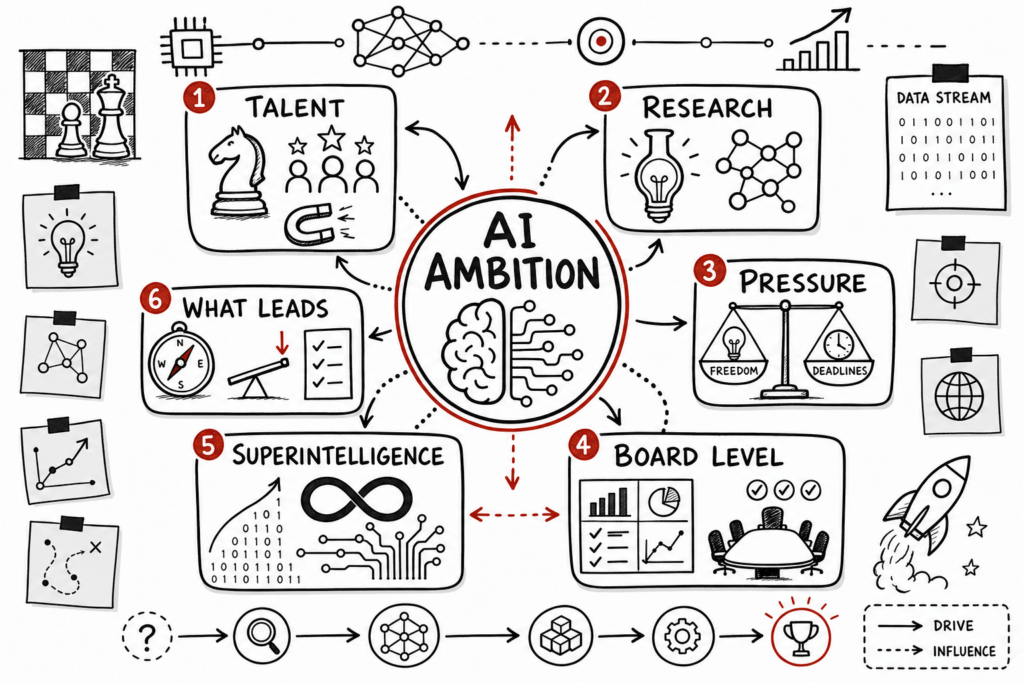
Short answer: The Infinity Machine: Demis Hassabis, DeepMind, and the Quest for Superintelligence, presented in the source as Sebastian Mallaby’s book, is a case study in frontier-AI ambition, research culture, talent and the tension between scientific possibility and commercial power.
This review is for leaders who want strategic literacy about AI without a technical implementation manual. The useful question is what kind of talent, governance, capital and organizational design are required when a company pursues a problem with unusually long horizons.
The Infinity Machine Summary: What the Book Is Really About
Mallaby uses DeepMind and Demis Hassabis to explore what happens when an organization is built around the pursuit of intelligence itself. The narrative is about people, decisions, institutional design and the movement from scientific possibility toward organizational reality.
It sits between a founder narrative, a frontier-technology briefing and a business reader’s introduction to superintelligence questions. Its value is not in teaching model mechanics. It is in showing how breakthrough organizations can look impractical or overly ambitious before their environment catches up.
Who Should Read It
Read it if you are a founder, executive, investor, board member, senior operator or adviser dealing with technology strategy, talent, innovation or long-term competitive positioning. It is also useful for leaders in real estate, finance, consulting and professional services who may not build AI systems but will be affected by them.
Skip it if you need a next-quarter implementation manual or a technical treatment of model architecture. This is a strategic and institutional story.
Core Idea
The core idea is that frontier-AI organizations are not ordinary software companies with shorter product cycles. They operate as a hybrid of research lab, startup, strategic asset and potential geopolitical variable.
That ambition requires architecture: recruitment standards, intellectual culture, patient capital, mission clarity and a way to manage exploration alongside execution. “Be visionary” is not an operating plan. The practical lesson is to build the conditions in which difficult work can be tested and governed.
Best Takeaways
1. Talent density is strategy, not HR
Rare talent is drawn by problem quality, peers, autonomy and proximity to meaningful work as well as compensation. Ask what mission and working environment your organization offers ambitious people, and whether the standard of work matches the story you tell about the future.
2. Research culture and commercial pressure are hard to balance
Research needs freedom, patience and tolerance for uncertainty. Commercial execution needs deadlines, products, customers and measures. Protect both by deciding which work merits exploration, which work must show near-term evidence and who makes the trade-off.
3. AI strategy is now board-level strategy
AI questions reach product design, hiring, data ownership, customer experience, security and capital allocation. The board need not design a model, but it should understand the dependency, governance and capability decisions that shape the organization’s exposure.
4. Superintelligence is a strategic scenario, not just a sci-fi topic
Readers will differ on timing and likelihood. A useful leadership response is scenario planning: what would change if capabilities improved faster than the organization could absorb? That question directs attention to governance, talent, data, vendor dependence and learning speed without claiming a date or outcome.
Where It Falls Short
The biography and institutional narrative may feel indirect to a reader who wants a step-by-step operating plan. The book explains how a frontier-AI institution emerged; it does not provide a 30-day adoption checklist.
Companies that look coherent in retrospect were also navigating uncertainty, trade-offs and disagreement. Readers should resist turning one organization’s story into a universal template. Use it to ask better questions about your own conditions.
How to Apply It
Start an AI-ambition review. Ask which problems are strategic, which capabilities are missing and which assumptions the leadership team is making about data, talent, time and risk.
Audit your AI ambition
Write the desired capability in one sentence, name the user and list the evidence that would justify further investment. Separate a research question from a product commitment and a public claim.
Reassess talent and learning speed
Review who understands the technical, client, legal, privacy and operational dimensions of the work. Identify how the team learns from tests and where a critical decision depends on one person.
Separate signal from theater
For every demonstration or vendor claim, ask what problem is solved, what data is required, what human review remains and how performance would be measured. A polished demo is not evidence of fit.
Build a frontier-watch habit
Set a recurring review for developments that could change your sector, then record the source, implication, uncertainty and decision owner. A watch habit is useful when it leads to a considered change in posture, not constant novelty.
Final Verdict
The Infinity Machine is a useful strategic reading choice for leaders who need context about frontier AI, talent and institutional ambition. It is strongest when treated as a case study rather than a forecast.
Read it to sharpen questions about capability, governance and organizational design, then test those questions against current evidence and the responsibilities of your own board and team.
You can request a complimentary one-hour conversation with a senior advisor who is an experienced operator. Talk through your next move when AI ambition needs a clearer strategic and governance conversation.