What Is The Singularity Is Nearer Summary for Business Leaders?
This The Singularity Is Nearer summary is for founders, executives, and luxury real estate leaders evaluating AI-human integration timelines and the strategic implication: plan for compounding capability shifts without betting the company on exact dates. In The Singularity Is Nearer, Ray Kurzweil argues that exponential progress in computing, AI, biotechnology, and brain-computer interfaces is moving humanity toward deeper AI-human convergence. A useful working definition: the singularity is the point where machine intelligence and human capability become so intertwined that productivity, cognition, and innovation cycles change faster than traditional planning models can absorb. For business readers, the immediate KPI is not whether Kurzweil’s date is perfectly right; it is whether AI reduces cycle time, service friction, cost per qualified lead, and decision latency over the next 12 to 36 months. Reader fit is strongest for leaders who need scenario planning, not certainty.
The Singularity Is Nearer Summary: The Strategic Premise
Ray Kurzweil is not writing a normal AI futures book summary. He is updating a long-running thesis: technology does not advance in a straight line. It compounds. His argument rests on exponential progress laws applied to computing power, data, AI models, biotech, nanotechnology, and eventually human-machine integration. You can explore Kurzweil’s broader work and historical forecasting archive at KurzweilAI, which gives useful context for how he frames these timelines.
The business value of the book is not that every prediction should be treated as a calendar invite. The value is that Kurzweil forces readers to stop thinking in five-year increments as if capability growth were linear. That matters if you are making decisions about technology infrastructure, recruiting, client experience, brand positioning, or operational leverage today.
This Ray Kurzweil The Singularity Is Nearer review is best read as a technology forecasting book review with a practical filter: what decisions would change if AI capability continues to improve faster than most organizations can culturally absorb? That is the question worth carrying through the book.
Who Should Read It
The Singularity Is Nearer is a strong fit for readers who already accept that AI is not a side tool. Founders, operators, investors, and senior leaders will get the most from it if they are building multi-year roadmaps and need a wider frame than quarterly software adoption.
Luxury real estate leaders should read it if they are responsible for high-trust client relationships in a market where speed, intelligence, discretion, and personalization are becoming table stakes. The book will not tell you which CRM to buy or which brokerage workflow to automate. It will, however, sharpen your sense of how quickly client expectations may rise once AI-enhanced search, valuation, design visualization, translation, and advisory tools become normal.
It is less useful for readers looking for a grounded implementation manual. If you need a step-by-step AI operations playbook, this is not that book. If you want a strategic horizon scan that pushes you to think beyond next year’s dashboard, it earns its place.
Core Idea
The core idea is simple and controversial: the convergence of AI, computing, biology, and human cognition is accelerating toward a future where the boundary between human and machine intelligence becomes increasingly porous. Kurzweil’s singularity timeline has always been debated, and this 2024 update arrives during a moment when generative AI has made his ideas feel less abstract to mainstream business audiences.
The useful move is to separate two questions. First, is Kurzweil right about the precise AI-human merger timelines? Second, does his framework help leaders prepare for a world where AI capability, automation, and augmentation keep improving faster than internal adoption habits? The second question is more actionable.
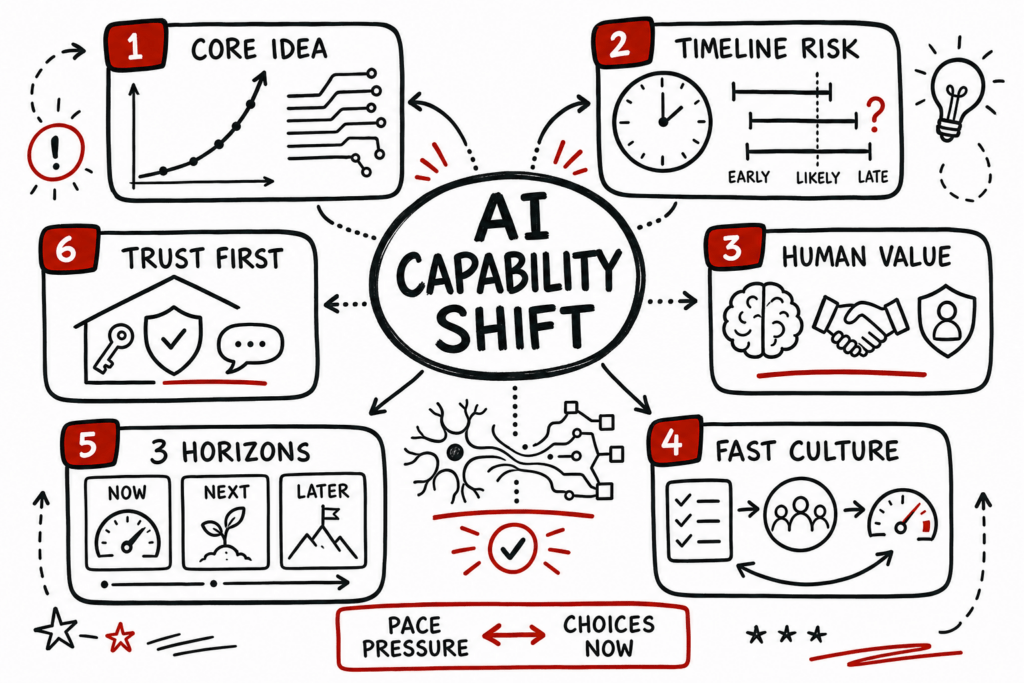
For strategy, the book encourages three-horizon thinking. Horizon one is present automation: AI that saves time, reduces errors, and improves customer response. Horizon two is augmentation: AI that improves judgment, personalization, research, negotiation prep, and creative output. Horizon three is integration: technology that reshapes how work, health, memory, learning, and human capability are experienced. Most businesses should not obsess over horizon three at the expense of horizon one. But ignoring horizon three leaves leadership teams underprepared for the direction of travel.
Best Takeaways
1. Exponential change punishes slow internal cultures
One of The Singularity Is Nearer key takeaways is that technical progress is not the same as organizational progress. A model may become dramatically more capable in six months, while a leadership team may still be debating whether employees are allowed to use it. That gap becomes a competitive liability.
For a real estate business, the practical issue is adoption velocity. Can your team test, govern, and scale useful tools in 30 to 90 days? Or does every improvement die in committee? The winners will not be the firms that chase every tool. They will be the firms with clean data, clear policies, and managers who know how to redesign work instead of merely adding software.
2. Forecasts are less valuable than scenario ranges
Kurzweil is famous for timelines. Readers often focus on whether the Ray Kurzweil singularity timeline is too aggressive. That debate matters, but it can distract from the better application: build strategy around ranges. Ask what changes if AI reaches your required performance threshold in two years, five years, or ten years.
For example, if AI-generated property intelligence can reliably summarize zoning, comparable sales, buyer behavior, local amenities, and renovation upside in minutes, the KPI is not novelty. It is reduction in research cycle time and improvement in advisory quality. That is a measurable business case.
3. Human value moves up the trust ladder
Kurzweil’s world does not make human leadership irrelevant. It makes weak human contribution easier to expose. If AI can draft, analyze, visualize, and compare at high speed, professionals must bring better judgment, taste, ethics, negotiation skill, emotional calibration, and accountability.
This is especially true in luxury real estate. Clients may welcome AI-powered intelligence, but they still want a trusted advisor when the decision is expensive, emotional, private, and reputational. The leadership lesson is not to compete with AI on raw output. It is to use AI to make human judgment more prepared, more responsive, and more precise.
Where It Falls Short
The main weakness of the book is also the main weakness of much futurism and AI strategy: confidence can outrun operational nuance. Kurzweil is compelling when he maps technological convergence. He is less satisfying when the reader wants detailed treatment of institutional drag, regulation, cybersecurity, labor politics, misinformation, or uneven access.
In business terms, the risk is that readers walk away with either breathless optimism or defensive skepticism. Neither is useful. The right posture is disciplined curiosity. Treat the book as a provocation, not a procurement plan.
Another limitation: timelines can become emotionally sticky. Once a reader latches onto a date, they may overbuild around it or dismiss the entire thesis if they doubt it. Strong leaders should resist both moves. A smart The Singularity Is Nearer analysis focuses less on whether one forecast lands exactly and more on which assumptions would materially affect strategy.
For a more management-oriented counterbalance, Harvard Business Review’s AI coverage at HBR is useful because it tends to focus on implementation, governance, workforce design, and leadership behavior rather than long-range futurism alone.
How to Apply It
Run a 12-month AI capability audit
List the 20 workflows that consume the most time, create the most client friction, or depend on repetitive knowledge work. In luxury real estate, this may include listing preparation, buyer briefings, market analysis, vendor coordination, showing follow-up, content production, client segmentation, and transaction documentation. Score each workflow by time cost, risk level, data quality, and client impact. Start with low-risk, high-frequency tasks.
Build a three-horizon adoption map
Use Kurzweil’s framework without copying his certainty. Horizon one: tools you can deploy now. Horizon two: capabilities likely to affect your service model within 24 to 36 months. Horizon three: structural shifts that could redefine client expectations, staffing, or brand differentiation. Review the map quarterly. AI strategy should not be an annual retreat document that dies in a folder.
Protect trust as a premium asset
The deeper AI moves into advisory work, the more clients will value transparency. Decide where AI can assist, where human review is mandatory, and where privacy rules must be strict. A luxury brand cannot afford sloppy automation that feels cheap, invasive, or inaccurate.
Train leaders before tools
The most important The Singularity Is Nearer leadership lessons are about mindset. Leaders need enough fluency to ask better questions: What data is this tool using? What decision does it improve? What failure mode matters most? What human review is required? What KPI proves this is worth keeping?
Measure adoption by outcomes, not enthusiasm
Track response time, lead quality, client satisfaction, research cycle time, cost per transaction support hour, content production speed, and error reduction. If a tool does not improve a real metric, it is theater. If it does, scale it carefully.
Final Verdict
The Singularity Is Nearer is not a calm little management book. It is a big-range forecast from a committed futurist with a long public record of pattern-based prediction. The strongest use case is not passive belief. It is strategic pressure-testing.
For business leaders, this The Singularity Is Nearer book review comes down to one practical conclusion: use the book to widen your planning horizon, then bring the conversation back to measurable operating choices. The future may not arrive on Kurzweil’s exact schedule, but capability shifts are already close enough to affect hiring, service design, client communication, and competitive positioning.
For luxury real estate leaders, the immediate strategy lesson is clear. Do not wait for AI-human merger timelines to become obvious before upgrading your operating model. Build the muscle now: cleaner data, faster experimentation, better governance, and a more valuable human advisory layer.
If you want more private-briefing style reviews on AI, leadership, and market positioning, read more RE Luxe Leaders strategy briefings or book a confidential strategy call to pressure-test what these shifts mean for your business.