
The Stimulated Mind Summary: Brain Health for High Performers
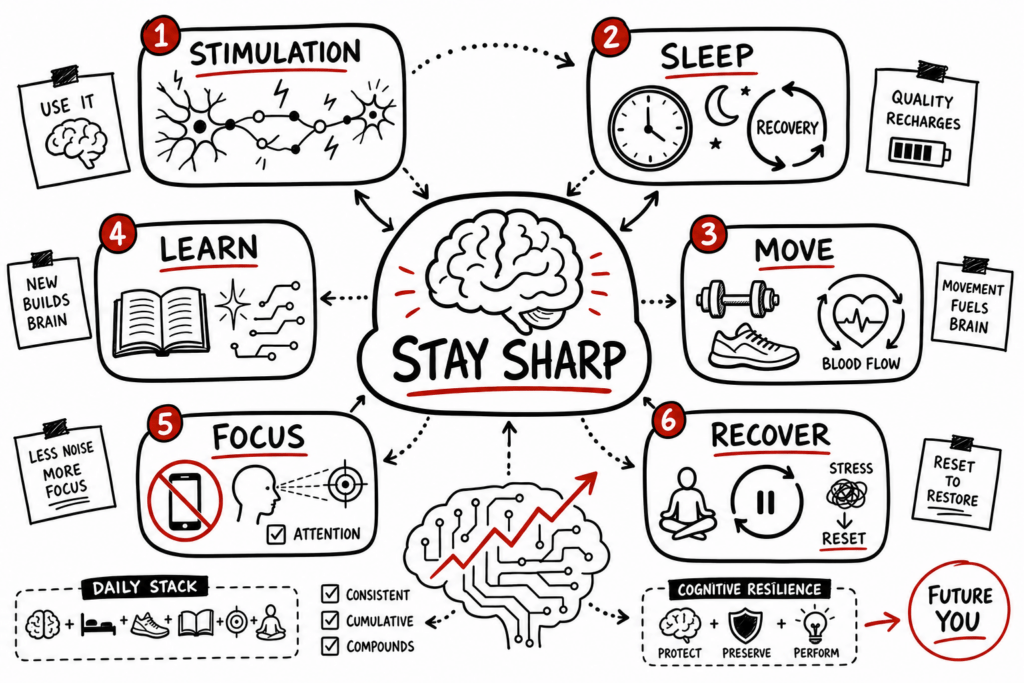
The Stimulated Mind summary: What the Book Is Really Arguing
The Stimulated Mind frames brain health as a long practice of useful stimulation and adequate recovery. The book is most helpful when it moves a reader away from frantic input and toward a small set of habits that protect attention, movement, sleep, learning and connection. It is a reading guide, not a clinical manual or a promise about an individual’s future health.
Public resources from the National Institute on Aging and the National Heart, Lung, and Blood Institute provide useful health context. They should be consulted directly for current evidence and personal questions.
Who Should Read It
The book may suit a busy reader whose work depends on judgment, pattern recognition, emotional regulation or sustained learning. It is also relevant to someone who can perform at a high level but has started to notice that recovery, travel, fragmented attention or inconsistent sleep carries a cost.
It is less suited to a reader seeking diagnosis, treatment, a detailed neuroscience text or a one-week transformation. Health history, genetics, environment and access to care remain part of any individual picture.
Core Idea
Cognitive resilience is supported by repeated cycles of challenge and recovery. Meaningful learning, physical movement, sleep, social connection and manageable stress can give a person better conditions for thinking. Constant notifications and crisis-driven work may feel stimulating without offering the same depth.
The leadership application is a design question: does the calendar make room for the inputs that support judgment? A leader can treat sleep, movement, emotional regulation and learning as operating conditions without pretending that habits control every health outcome.
Best Takeaways
1. Cognitive health is built before it is needed
Pay attention before a problem becomes urgent. A steady routine gives a reader more information about what supports energy and focus, while leaving room for factors that no personal plan can control.
2. Stimulation must be intentional, not constant
Busy input is not the same as useful challenge. Choose a difficult learning task, a real conversation or creative work that asks for sustained attention, then protect quiet space around it.
3. Movement is a brain strategy
Movement belongs in a cognitive routine because it can support general health, mood and daily function. Choose activity that is safe and sustainable for the person doing it; a clinician can help when symptoms, injury or medical conditions change the decision.
4. Recovery is not weakness
Sleep and downtime create conditions for learning and emotional steadiness. The practical point is to stop treating exhaustion as proof of commitment and to notice whether late work, travel or alcohol is undermining the next day.
5. Novelty keeps the system alive
A new language, instrument, sport, subject or community can create meaningful challenge. Novelty does not require a dramatic reinvention; it requires attention to something that is not already automatic.
Where It Falls Short
Brain-health writing can slide into overconfidence. A reader should not mistake practical habits for immunity from dementia, decline or illness. The strongest reading posture is disciplined optimism: act on what can be changed, measure the pattern carefully and seek qualified care for a personal concern.
The framework can also leave a busy person with too many priorities. Start with one sleep anchor, one movement habit and one serious learning practice. Review the effect before adding another commitment.
The Stimulated Mind Review: Strategy Lessons for Leaders
The book’s leadership value is indirect. A leader who protects attention and recovery may make more deliberate decisions, but the book cannot promise a business result. The useful question is whether the operating rhythm leaves enough capacity to notice risk, listen well and hold complexity.
That standard applies to the leader’s culture as well. Teams learn from what a leader normalizes. A calendar that rewards only urgency teaches reactivity; a calendar that makes room for preparation and recovery makes better judgment easier to practice.
How to Apply It
Run a seven-day cognitive audit
Record sleep and wake times, movement, late screens, deep work, social contact and how focused you felt. Treat the notes as observations, not a score. The aim is to see one pattern that deserves attention.
Protect one non-negotiable sleep anchor
Choose a consistent wake time or a clear boundary for late work. If sleep is persistently difficult or you have symptoms, bring the record to a qualified health professional.
Train for the brain, not just the mirror
Choose a safe mix of movement that supports strength, cardiovascular capacity, coordination or enjoyment. The best routine is one you can repeat and adapt to your health context.
Schedule one deep learning block
Set aside a weekly block for a hard, non-urgent subject. Study an unfamiliar market, practice a language or read outside your professional lane. Keep the task specific enough to begin.
Reduce low-grade cognitive pollution
Remove one reflexive input such as late email, repeated news checks or meetings without a decision. Less noise creates room to notice what the demanding work is asking of you.
Final Verdict
The Stimulated Mind is worth reading for a practical conversation about challenge, recovery and the conditions that support sustained attention. Read it selectively, test a few habits over time and keep personal health decisions with the professionals responsible for them.
You can request a complimentary one-hour conversation with a senior advisor who is an experienced operator. Talk through your next move