What Is the Tiny Experiments Summary for Leaders?
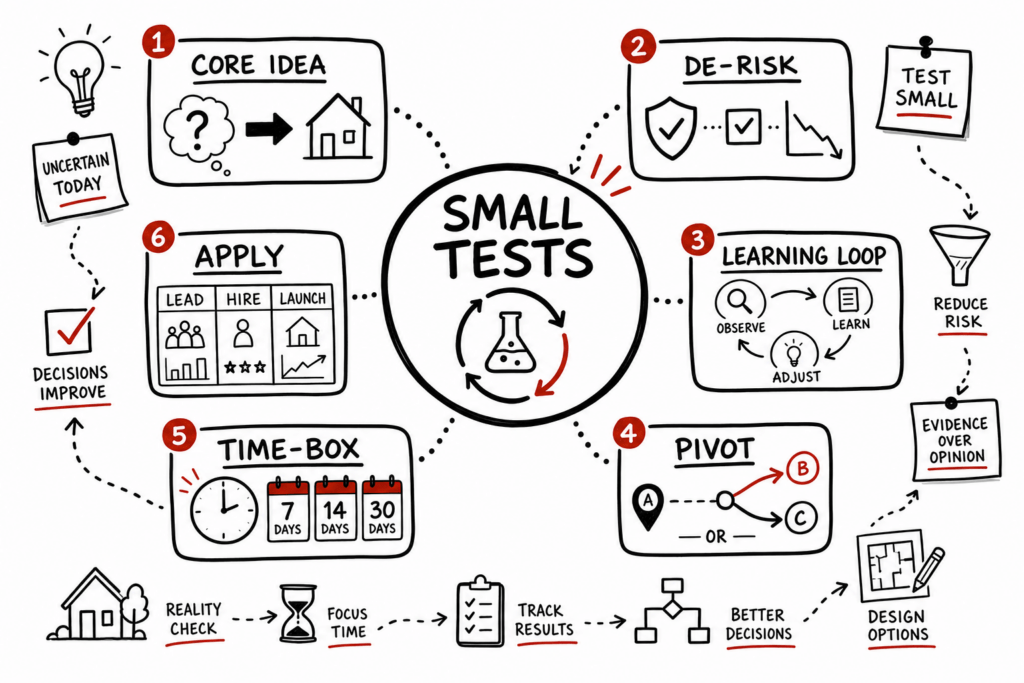
This Tiny Experiments summary is for real estate founders, operators, and ambitious professionals evaluating Anne-Laure Le Cunff’s case for using small tests to make better strategic decisions under uncertainty. In Tiny Experiments, the core idea is simple: replace rigid, high-pressure goals with low-risk learning loops that reveal what actually works before you overcommit money, time, or reputation. A useful working definition: a tiny experiment is a reversible test with a clear question, a short time frame, and a measurable learning signal, such as testing one acquisition channel for 14 days before hiring a full-time marketer. The strategic implication is strong for leaders facing pivots: the book is less about productivity theater and more about reducing decision risk. Reader fit is best for people who over-plan, stall, or treat every business move like a permanent identity decision.
Book Overview and Context
Tiny Experiments by Anne-Laure Le Cunff arrives at the right moment. Founder communities, executive teams, and high-performing professionals are exhausted by two broken defaults: obsessive goal-setting on one side and vague intuition on the other. Le Cunff, known for Ness Labs and her work around mindful productivity, argues for a third path: experiment your way through uncertainty instead of pretending you can forecast your way through it.
This is not a traditional productivity book promising a cleaner calendar or a five-step morning routine. It sits closer to an adaptive leadership book review conversation: how do you move when information is incomplete, markets shift, and the cost of being wrong is real? That makes it especially relevant for real estate leaders dealing with interest rate volatility, shifting buyer psychology, operating margin pressure, hiring constraints, and changing capital availability.
For context on the author’s broader work, her platform Ness Labs has long explored metacognition, learning, and knowledge work. The book extends that worldview into a practical operating philosophy: do not wait for perfect confidence. Build a small test that makes the next decision clearer.
Who Should Read It
The best Tiny Experiments reader fit is not the person looking for motivation. It is the person with too many high-stakes decisions and too little reliable feedback. If you lead a brokerage, manage a real estate investment firm, run a development shop, build a proptech company, or operate a high-performing advisory practice, this book gives you a useful mental model for uncertainty.
It will also help professionals in transition: a senior agent considering a niche shift, a founder deciding whether to expand into a new market, or an operator trying to decide if a new hire, software platform, or client segment deserves more investment. The book’s strongest audience is made up of capable people who tend to overthink because the stakes are not imaginary.
It is less useful if you want a dense research manual, a full operating system, or a tactical real estate playbook. This is a decision-making philosophy with practical prompts, not a market-specific strategy guide.
Core Idea
The core idea of this Tiny Experiments book review is that small experiments protect leaders from the false comfort of certainty. Instead of setting a fixed outcome and forcing reality to comply, you ask a sharp question, run a contained test, observe the result, and adjust.
That sounds obvious until you compare it with how many leaders actually operate. A founder decides to expand into luxury rentals because the market feels promising. A team adopts a new CRM because a peer firm praised it. A principal hires ahead of demand because the annual plan says growth must happen. These may be reasonable moves, but they are often treated as commitments before they are tested as assumptions.
Le Cunff’s argument is to lower the cost of learning. In real estate, that could mean testing a single investor webinar before building a full education funnel, piloting one neighborhood farming campaign before rolling out a regional brand push, or shadowing a new operations process with two agents before requiring the whole team to adopt it.
The leadership shift is emotional as much as strategic. Tiny experiments let ambitious people detach learning from ego. A failed test is not a personal failure. It is data collected cheaply.
Best Takeaways
1. De-risk decisions before they become expensive
One of the strongest Tiny Experiments key takeaways is the discipline of making decisions reversible whenever possible. Leaders often wait until they can justify a large move, but by then sunk cost pressure is already building. A 30-day micro-test can reveal demand, friction, and operational complexity before the budget gets political.
For example, instead of launching a full acquisition campaign targeting out-of-state investors, a real estate founder could test three messages with a small paid audience, measure booked calls under a defined cost-per-qualified-lead threshold, and only scale the winner. That is small experiments decision making in practical form.
2. Replace outcome obsession with learning loops
The book challenges the common executive habit of confusing goals with control. Goals are useful, but in uncertain environments they can become brittle. A learning loop is different. It asks: what did we expect, what happened, what did we learn, and what will we change?
This is one of the best Tiny Experiments leadership lessons because it changes team culture. When leaders reward only outcomes, teams hide uncertainty. When leaders reward intelligent experiments, teams surface weak signals earlier. That matters in volatile real estate cycles, where early information is often more valuable than perfect information.
3. Treat pivots as evidence-based transitions
Many professionals frame pivots as dramatic identity changes. Le Cunff’s approach makes them smaller and safer. A broker does not need to announce a full rebrand to test a luxury downsizer niche. An operator does not need to rebuild the company around AI to test one automation workflow. A sponsor does not need to enter a new asset class before interviewing 20 investors and underwriting three sample deals against current debt assumptions.
This is where Tiny Experiments for leaders becomes especially useful. The book gives permission to move without pretending the move is final.
Tiny Experiments Strategy Lessons for Real Estate Leaders
Real estate rewards conviction, but it punishes untested conviction. The strongest Tiny Experiments strategy lessons apply to three areas: acquisitions, operations, and growth.
In acquisitions, a tiny experiment might be testing a new sourcing channel with a fixed two-week outreach sprint. The question is not whether the channel is perfect. The question is whether it produces enough qualified conversations to justify more time.
In operations, a leader might test a new listing coordination process with one pod before rolling it out companywide. The measurable signal could be fewer missed deadlines, faster document turnaround, or reduced founder involvement. If the process creates more confusion than clarity, the test has done its job.
In growth, a boutique advisory team could test a quarterly private briefing for past clients before investing in a large content platform. Track attendance, referral conversations, and follow-up appointments. If the signal is strong, scale. If not, adjust the offer before spending heavily on production.
This is the practical bridge between an Anne-Laure Le Cunff Tiny Experiments reading and a real operating environment. The book is not telling leaders to be casual. It is telling them to be more precise about what they are trying to learn.
Where It Falls Short
The main weakness is that the concept can feel deceptively simple. Some readers may finish thinking, I already know this. But knowing and operating this way are different things. The value is not in novelty alone; it is in discipline.
That said, readers looking for more rigorous business case studies may want more depth. The book’s philosophy is broadly applicable, but real estate leaders will need to translate it into their own metrics, constraints, and decision rights. A tiny experiment in a solo consulting practice is very different from one inside a capital-intensive development firm.
There is also a risk of overusing experimentation as a way to avoid commitment. Not every decision should remain in test mode forever. At some point, leaders need to decide, allocate resources, and accept exposure. The book is strongest when experiments are treated as a path to commitment, not a substitute for it.
For readers wanting to explore the author’s ongoing thinking around learning and knowledge work, the Ness Labs blog is a useful companion resource. It gives more context for the mental models behind the book.
How to Apply It
Use this book as a decision filter, not a lifestyle slogan. Start with one live business question where the answer is uncertain and the cost of being wrong is meaningful.
Here is a simple application sequence:
1. Name the assumption
Do not start with the project. Start with the belief underneath it. Example: We believe luxury sellers in this submarket will respond to private valuation briefings better than generic listing ads.
2. Shrink the test
Design the smallest credible version. Instead of building a full campaign, invite 25 qualified homeowners to one private briefing and measure responses.
3. Set the learning metric
Define success before you begin. For example: five booked valuation calls, two referral conversations, or a 20 percent reply rate. The number does not need to be universal; it needs to be honest.
4. Time-box it
A tiny experiment should not become an endless pilot. Set a deadline: 7 days, 14 days, 30 days. The shorter the loop, the faster the learning.
5. Decide the next move
At the end, choose one of three options: scale it, adjust it, or stop it. The point is not to collect interesting observations. The point is to improve strategic action.
For a real estate founder, this approach can reduce drama around hiring, market expansion, content strategy, lead generation, investor relations, vendor selection, and internal process changes. It gives teams a shared language for intelligent risk.
Final Verdict
Tiny Experiments is a smart, calm, and useful read for leaders who need to make decisions without pretending uncertainty has disappeared. It is not a magic productivity system, and it will not replace judgment. But it will improve the quality of judgment by forcing assumptions into the open and lowering the cost of learning.
As a Tiny Experiments productivity book, its real strength is not getting more done. It is helping you stop overcommitting to the wrong things. For real estate leaders, that may be exactly the advantage the current market requires.
If you want more private-briefing style strategy reads for founders, operators, and luxury real estate leaders, explore more RE Luxe Leaders book reviews and strategy briefings. If the decision in front of you is too nuanced for a generic framework, book a confidential strategy call.