What is The Algebra of Wealth summary for high-earning professionals?
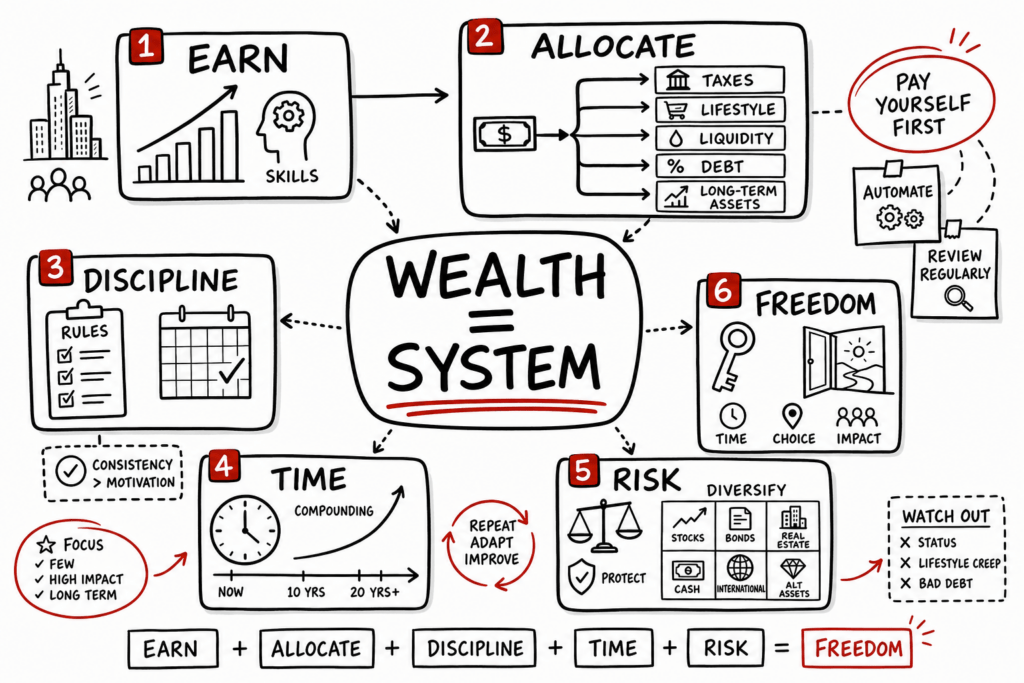
The Algebra of Wealth summary is this: Scott Galloway’s The Algebra of Wealth gives high-earning professionals, especially real estate operators, executives, and firm owners, a blunt framework for turning income into durable financial security rather than lifestyle drift. Its strategic implication is clear: wealth is not the same as earnings; it is the result of career focus, disciplined saving, risk-aware investing, and time. A useful operating definition for this review: capital allocation means deciding, in advance, how each incremental dollar is split between taxes, lifestyle, liquidity, debt reduction, operating reinvestment, and long-term assets. For affluent readers, the practical KPI is not gross commission income or firm revenue; it is after-tax investable surplus consistently converted into appreciating assets. If you want a tactical manual with spreadsheets, this is not it. If you want a memorable decision framework for career strategy and investing, it is worth reading.
Who Should Read It
This The Algebra of Wealth review is written for ambitious professionals who already know how to make money but want a cleaner system for keeping and compounding it. The best reader fit for The Algebra of Wealth is the person with meaningful earning power, a demanding calendar, and too many financial decisions competing for attention.
Real estate professionals are a particularly strong match. Agents, team leaders, developers, brokerage owners, and property entrepreneurs often live with uneven income, tax shocks, concentration risk, and pressure to signal success. Galloway’s message lands because he treats wealth as behavior under pressure, not just math on a brokerage statement.
If you are looking for a technical tax guide, a real estate investing playbook, or a stock-picking system, this book will feel broad. If you want a high-level financial security book summary that connects ambition, discipline, career design, and investing, the book gives you a usable frame. You can view the official publisher page for The Algebra of Wealth by Scott Galloway for publication details.
Core Idea
The core idea is that wealth is not built by income alone. Galloway’s argument is closer to an operating equation: focus your career, avoid self-sabotage, invest consistently, and let time do the heavy lifting. The book is not subtle about the gap between appearing rich and becoming secure. That distinction matters for high earners because lifestyle inflation can quietly consume a seven-figure opportunity.
As a Scott Galloway book summary, the cleanest read is this: the book is about building a life where money reduces fragility. Galloway is not trying to make you love frugality for its own sake. He is arguing that financial independence gives you better choices: where to work, whom to work with, which clients to keep, what risks to decline, and when to stop chasing approval.
For a real estate professional finance lens, the book is most useful when applied to personal balance-sheet design. Many successful operators confuse business revenue, deal flow, and personal wealth. They are related, but not identical. A productive year in commissions or fees only becomes wealth if a defined share moves into reserves, diversified investments, debt reduction, or durable ownership.
Best Takeaways
1. Earning power is a strategy, not an accident
One of the stronger The Algebra of Wealth key takeaways is that income quality matters. Galloway pushes readers to think about career choices as compounding assets. Proximity to growth industries, leverage, brand, scarcity of skill, and ownership all affect long-term earning power.
For a brokerage owner, this means asking a harder question than how do we recruit more agents? The better question is: what part of this business compounds without my constant intervention? For a top producer, it may mean building referral systems, niche authority, junior talent, or intellectual property rather than simply adding more showings to an already overloaded week.
2. Discipline beats financial theater
The book is very good on the emotional traps of wealth building. High earners are vulnerable to expensive identity cues: the house, the car, the vacation, the watch, the table, the constant proof that business is good. Galloway’s point is not that luxury is immoral. It is that unmanaged status spending can become a tax on freedom.
A useful leadership takeaway: set rules before revenue arrives. For example, a firm owner might decide that 30 percent of every owner distribution goes to long-term investments, 10 percent to liquidity, and bonuses are only paid after tax reserves are funded. The exact numbers depend on the person, but the principle is transferable: automate the adult decision before the emotional decision shows up.
3. Time horizon is an asset
The book’s investing discussion is not groundbreaking, but it is valuable because it is repeated in plain language. Galloway favors patient participation in markets over cleverness. For affluent readers, the issue is often not access to information. It is overconfidence, concentration, and impatience.
This is where the book works as a wealth strategy book review for professionals with volatile income. If your income already depends on real estate cycles, local market liquidity, credit conditions, and client confidence, your personal portfolio should not blindly double down on the same risks. The point is not to avoid real estate. The point is to know when your career, operating company, and investment portfolio are all exposed to one weather system.
4. Wealth is also a character test
Galloway writes about money as a behavioral and relational subject, not just an investing subject. That is one reason the book resonates with performance-driven audiences. The hard part is not knowing that you should save, invest, and avoid dumb risks. The hard part is doing it while peers are upgrading, markets are noisy, and your ego wants evidence that you are winning.
Where It Falls Short
The main weakness is that some advice stays at the principle level. Readers who want exact portfolio construction, tax strategies, entity planning, estate structures, or real estate-specific capital stacks will need more specialized guidance. This is not a private wealth manual. It is a worldview with enough practical direction to challenge bad habits.
Another limitation: Galloway’s voice can be polarizing. Some readers will appreciate the bluntness. Others may find the confidence stronger than the nuance. The book is best read as a strategic prompt, not as a personalized financial plan.
The investing material also covers familiar ground: diversify, save aggressively, respect compounding, avoid speculation disguised as sophistication. These are not new capital allocation lessons. The value is in how the book packages them for readers who may be brilliant at earning and surprisingly casual about keeping score.
How to Apply It
Build your personal capital allocation rule
Start with one written rule for each dollar of after-tax income. A simple version: lifestyle, liquidity, long-term investing, debt management, and business reinvestment. Then assign target percentages. The goal is not perfection. The goal is to prevent every good year from becoming a spending year.
Separate business success from household security
Real estate entrepreneurs often hold too much net worth inside the same ecosystem that creates their income. Audit your exposure. How much of your wealth depends on local property values, transaction volume, interest rates, or one operating company? If the answer makes you uncomfortable, that discomfort is useful data.
Use a freedom KPI
Track one number monthly: investable surplus. This is the amount left after taxes, essential spending, debt obligations, and required reserves. Revenue is vanity if surplus is weak. Net worth is directionally useful, but surplus reveals whether your current behavior is building future optionality.
Run a decision filter before lifestyle upgrades
Before any major recurring expense, ask: does this improve health, relationships, earning power, or freedom? If the honest answer is no, it may still be worth buying, but it should be treated as consumption, not success.
Respect compounding without making it mystical
Compounding is simply growth on prior growth over time. Use conservative assumptions and let consistency do more work than prediction. For a quick illustration, the U.S. Securities and Exchange Commission provides an accessible compound interest calculator at Investor.gov. The lesson is not that calculators make you wealthy. The lesson is that delay has a visible cost.
Final Verdict
The strongest The Algebra of Wealth lessons are not exotic. They are clarifying. Galloway reminds high earners that financial security is built through repeated decisions that may feel boring in the moment and powerful a decade later.
For real estate leaders, the book is most useful as a mirror. Are you building a business that creates wealth, or a business that funds an expensive identity? Are you allocating capital before emotions get involved, or after the market, client pressure, and peer comparison have already shaped the decision?
My verdict: read it if you want a sharp, accessible framework for career strategy and investing. Pair it with your own CPA, advisor, estate attorney, and a written allocation policy. The book will not do the math for you, but it will make it harder to pretend the math does not matter.
For more private-briefing style reviews and strategy notes for ambitious real estate professionals, read more RE Luxe Leaders briefings or book a confidential strategy call when you are ready to turn insight into a cleaner operating plan.