What is the best Feel-Good Productivity summary for executives?
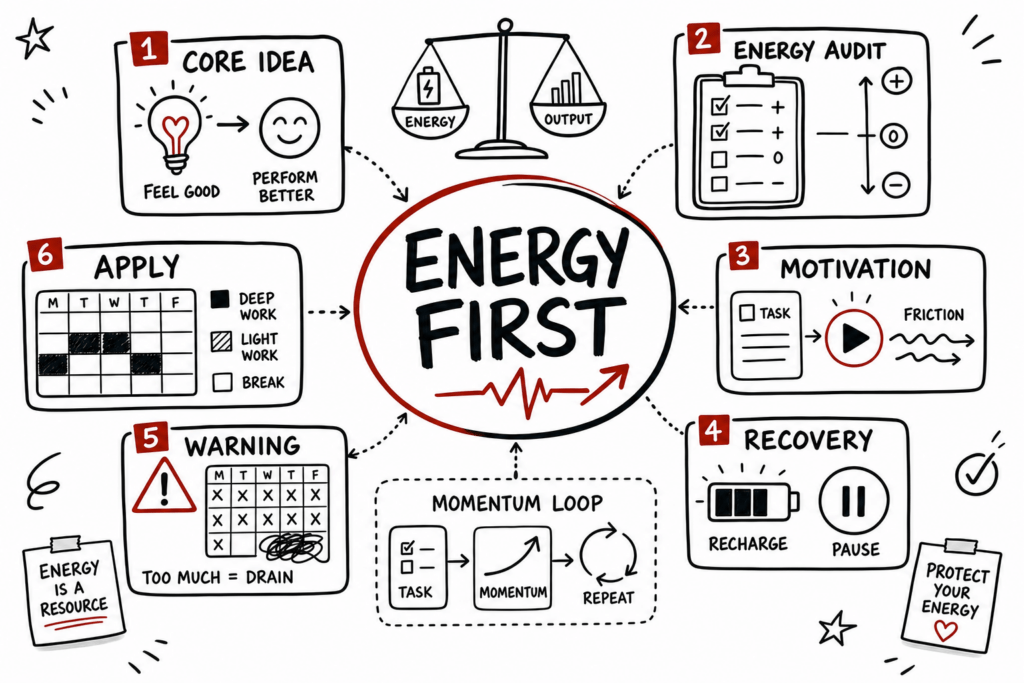
This Feel-Good Productivity summary is for executives, operators, and ambitious professionals evaluating Ali Abdaal’s Feel-Good Productivity and its strategic implication: sustainable performance improves when work is designed to generate energy, not merely extract discipline. Abdaal’s core argument is that positive emotion is not a reward after productivity; it is a performance input. A useful working definition here is “feel-good productivity”: structuring tasks, habits, and environments so motivation, focus, and recovery reinforce one another over time. For a leadership reader, the practical KPI is not hours worked, but high-quality output per energy cost—for example, fewer low-value meetings, faster decision cycles, and a calendar that protects deep work and recovery. Reader fit: choose this book if you want an accessible, evidence-informed operating system for reducing burnout risk while maintaining output; skip it if you need a rigorous academic manual or a highly technical performance protocol.
Book Context and Author Background
Feel-Good Productivity comes from Ali Abdaal, a former physician who became one of the best-known productivity educators online. That background matters. He is not writing as a corporate theorist or a military-style performance coach. His lane is translation: taking behavioral science, self-management practices, and lived experience, then converting them into simple systems people can actually use on a busy Tuesday.
The book sits in the modern evidence-based productivity book category, but it deliberately pushes against the older “push harder, wake earlier, optimize every second” genre. Abdaal’s bet is that many ambitious people are not underperforming because they lack ambition. They are underperforming because their work systems are emotionally expensive. The result is inconsistent output, procrastination, avoidance, and burnout disguised as discipline.
That makes the Ali Abdaal Feel-Good Productivity approach especially relevant for operators, founders, senior agents, team leaders, and high-responsibility professionals. If your calendar is full, your attention is fragmented, and your work depends on judgment rather than brute labor, the book has real utility.
Who Should Read It
This is a strong fit for professionals who already know the basics of productivity but have hit the ceiling of willpower. If you have tried time blocking, task managers, morning routines, and annual planning, yet still feel drained by the work that supposedly matters most, this book gives you a more humane diagnostic lens.
It is also useful for leaders who manage high-output teams. The best Feel-Good Productivity leadership lessons are not about making everyone happier in a vague cultural sense. They are about recognizing that energy, autonomy, clarity, and recovery directly affect execution quality. A team drowning in status meetings, ambiguous priorities, and performative urgency will not be saved by another productivity app.
Who should not read it? If you want a dense research monograph, this may feel too accessible. If you want aggressive hustle rhetoric, you will be disappointed. And if your main problem is structural—understaffing, a broken incentive model, or a toxic executive environment—no personal productivity framework will fully compensate for that.
Core Idea
The core idea is simple but strategically important: feeling good is not the opposite of being productive. It can be the mechanism that makes productivity sustainable. Abdaal argues that positive emotions such as curiosity, confidence, play, and purpose improve the likelihood that people start hard tasks, persist through friction, and recover well enough to repeat the process.
For executive readers, the sharper interpretation is this: your emotional operating environment is part of your performance infrastructure. A calendar that creates dread will eventually tax decision quality. A task list with no visible progress will invite avoidance. A team culture that rewards constant urgency will quietly degrade creative problem-solving.
This is where the book is most useful as a productivity book summary for ambitious professionals. It reframes productivity from “How do I force myself to do more?” to “How do I design work so the right actions become easier to begin, easier to sustain, and less costly to repeat?” That is a better question for long-term operators.
Best Takeaways
1. Energy is a management metric, not a mood
One of the strongest Feel-Good Productivity key takeaways is that energy should be treated as a measurable leadership input. Most executives track revenue, pipeline, utilization, deal flow, or client satisfaction. Fewer track the calendar patterns that make those results either sustainable or brittle.
A practical move: audit your week by energy cost. Mark meetings, decisions, tasks, and conversations as energizing, neutral, or draining. Then look for patterns. Are your highest-value decisions happening after back-to-back calls? Are you using your best cognitive hours on inbox triage? Are you ending each day with the work that requires the most emotional courage?
2. Motivation improves when work has emotional texture
Abdaal is persuasive on the point that motivation is not purely internal. The way a task is framed, sequenced, and supported changes whether it feels approachable. This has real business application. A leader can make a strategic planning process feel like a bureaucratic obligation, or like a focused design sprint with visible stakes, clear ownership, and momentum.
That does not mean turning serious work into entertainment. It means reducing unnecessary friction and increasing agency. For a real estate executive, that might mean replacing a vague “grow referrals” goal with a weekly relationship block, a defined outreach list, and a simple scoreboard. The work becomes easier to start because the next move is obvious.
3. Recovery is part of the production cycle
The book is strongest when it normalizes recovery as a performance requirement, not a luxury. This aligns with broader business concern around burnout, a topic tracked closely by sources such as Harvard Business Review’s burnout coverage. The relevant leadership lesson is not “take more vacations” in isolation. It is to design a cadence where recovery is not perpetually postponed until after the next launch, listing push, board meeting, or hiring cycle.
If the organization’s success depends on sustained judgment, recovery must be built into the operating model. Otherwise, the business is borrowing against the nervous system of its top performers.
Where It Falls Short
This Feel-Good Productivity review would be incomplete without saying that the book can occasionally feel broad. Because Abdaal is writing for a wide audience, some ideas are necessarily simplified. Experienced executives may recognize familiar concepts from behavioral psychology, habit design, positive psychology, and time management.
The other limitation is that the book leans toward personal agency. That is useful, but it can understate how much productivity is shaped by power, incentives, headcount, market volatility, and organizational design. A burned-out leader may not need a better morning routine. They may need to renegotiate role scope, restructure decision rights, replace a recurring meeting culture, or stop tolerating clients who destroy margin.
There is also a risk that “feel-good” gets misread as comfort-seeking. That is not the best reading of the book. The more sophisticated interpretation is not “only do work that feels pleasant.” It is “build enough energy, meaning, and momentum that you can keep doing difficult work without becoming depleted or avoidant.”
Feel-Good Productivity Strategy Lessons
The best Feel-Good Productivity strategy lessons are about system design. High performers rarely fail because they do not care. They fail because their systems depend on heroic effort too often. Heroics are useful in a crisis and dangerous as a business model.
For leadership teams, the book supports three strategic questions. First: where are we confusing activity with value? Second: what recurring work drains senior attention without improving outcomes? Third: what would change if we optimized for decision quality over calendar density?
A useful comparison point: traditional productivity books often ask, “How can I get more done?” Abdaal’s framework asks, “How can I make meaningful work more energizing and therefore more repeatable?” That is a better question for professionals whose value comes from judgment, relationships, negotiation, creativity, and trust.
How to Apply It
Run a two-week energy audit
For two weeks, rate each major work block from -2 to +2. A -2 leaves you depleted and less effective. A +2 gives you momentum. At the end, identify the top three recurring drains. Do not start by redesigning your whole life. Start by removing or reshaping the patterns that repeatedly tax your highest-value hours.
Redesign one high-friction task
Pick a task you avoid but cannot delegate. Examples: pipeline review, difficult client follow-up, financial review, recruiting outreach, or content creation. Make the next step smaller, add a clear trigger, pair it with a more energizing context, and define a visible finish line. The goal is not inspiration. The goal is lower activation energy.
Protect decision-quality windows
Choose two or three weekly blocks for your highest-leverage thinking. Treat them like client meetings. Use them for pricing decisions, talent calls, negotiation prep, investment review, or strategic planning. If everything else invades these blocks, the issue is not productivity. It is governance.
Use the framework with your team
Ask direct reports: “Which recurring part of your work creates the most value, and which creates the most drag?” Then compare answers against business outcomes. You may find that your best people are spending premium attention on low-trust workflows, unclear approvals, or internal noise. Fixing that is a leadership productivity gain, not a wellness perk.
Final Verdict
Feel-Good Productivity is not a magic system, and it is not trying to be. Its value is in giving ambitious people permission to stop treating exhaustion as proof of seriousness. For executives and operators, the book is most useful when applied as a performance design lens: build work systems that create enough energy to sustain high standards.
The Feel-Good Productivity reader fit is clear. Read it if you want accessible, evidence-informed tactics for making important work easier to start and less costly to sustain. Pair it with harder business analysis if your bottleneck is structural. The strongest move is to take one idea from the book and apply it to your calendar, not your bookshelf.
For more no-fluff strategy briefings like this, read the next RE Luxe Leaders review—or book a confidential strategy call when you are ready to turn insight into an operating advantage.