What Is the Clear Thinking Summary for Leaders?
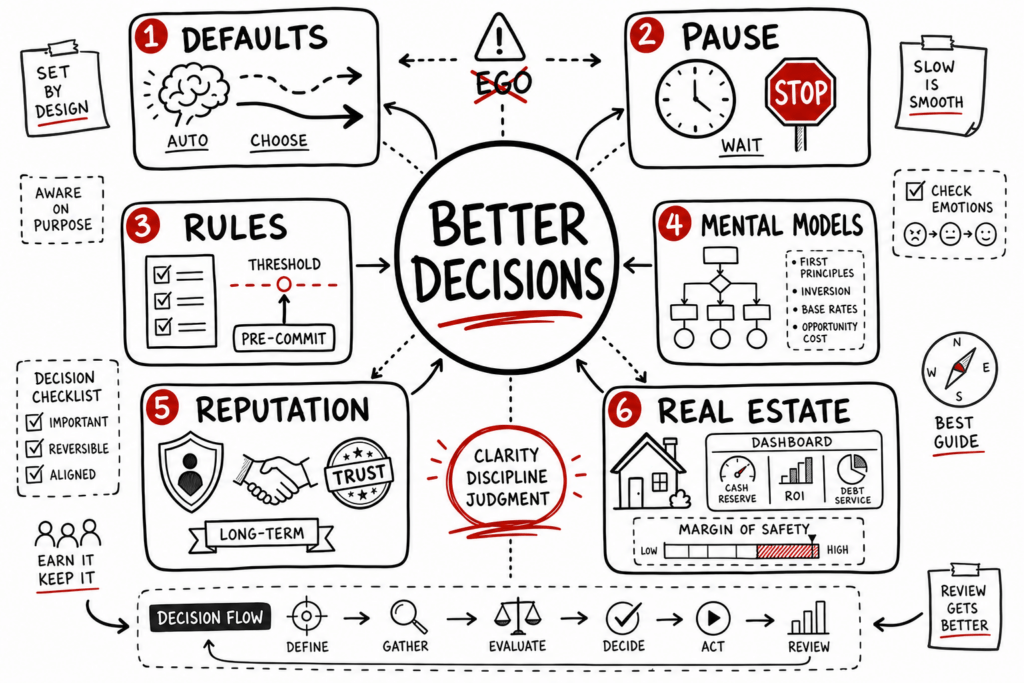
Clear Thinking summary: Clear Thinking by Shane Parrish is a decision-making book for founders, managing brokers, and senior operators who need fewer avoidable errors under pressure. Its core idea is that better outcomes rarely come from one heroic insight; they come from managing default reactions, creating decision space, and using simple frameworks before emotion, ego, inertia, or social pressure take over. For real-estate leaders, the strategic implication is practical: the difference between a disciplined operator and a reactive one often shows up in measurable decisions such as hiring thresholds, deal walk-away criteria, cash reserve policy, and when to pause expansion. A useful working definition from the book’s spirit is this: clear thinking is the ability to separate what is happening from what you want to be true before committing resources. If you want tactics, not theory theater, this is worth your attention.
Book Overview and Author Context
Shane Parrish is best known for Farnam Street, the long-running platform focused on mental models for decision making, judgment, and practical wisdom. That background matters because Clear Thinking is not written like a motivational leadership book. It is closer to an operator’s field guide: identify the conditions that lead to bad judgment, build a process that protects you from yourself, and improve the odds before the stakes are emotional.
The official publisher page for Clear Thinking by Shane Parrish positions the book around everyday moments that compound into major life and business outcomes. That is the right lens. This is not only about boardroom strategy. It is about the tiny leadership moments that precede expensive consequences: replying too fast to a difficult agent, approving a marginal hire because the team is stretched, chasing volume when margin is weakening, or accepting a client relationship that will drain the organization.
For RE Luxe Leaders readers, this Clear Thinking book review is less interested in whether the book sounds smart and more interested in whether the tools travel into real operating conditions. On that test, it mostly performs.
Who Should Read It
Read Clear Thinking if you are a founder, principal broker, team leader, developer, investor, or senior operator who makes fast calls with incomplete information. The book is especially useful if your business depends on repeated judgment calls: who to hire, which listing to take, when to cut losses, how much leverage to carry, when to push growth, and when to protect reputation over revenue.
It is also a strong fit if you are looking for a decision-making book for leaders but do not want dense academic writing. Parrish writes for people who have calendar pressure, payroll responsibility, and limited tolerance for abstraction. The book’s value is in the way it makes invisible decision errors visible.
Skip it, or at least lower your expectations, if you want a real-estate-specific manual, a negotiation playbook, or a detailed implementation system with worksheets. This is not a brokerage operating manual. It is a judgment manual. You bring the business context.
Core Idea
The central argument of Clear Thinking is that most poor decisions are not caused by a lack of intelligence. They are caused by defaults. Under pressure, people fall back on instinctive patterns: defending status, avoiding discomfort, following the crowd, protecting ego, or choosing immediate relief over long-term advantage. The book’s move is to slow that pattern down before it becomes a commitment.
That is why Shane Parrish Clear Thinking has resonated in leadership and strategy circles. The promise is not that you can become perfectly rational. You cannot. The promise is that you can design your environment, questions, and decision process so your worst defaults have less room to run the business.
For a managing broker, this might mean deciding in advance what qualifies as a productive agent, not redefining the standard every time a charismatic underperformer asks for another exception. For a founder, it might mean writing investment criteria before seeing the shiny acquisition opportunity. For a luxury team leader, it might mean defining brand-protective client standards before a high-commission but toxic listing appears.
Best Takeaways
1. Decision quality starts before the decision
One of the strongest Clear Thinking key takeaways is that the moment of choice is often too late. By the time you are angry, flattered, scared, or rushed, your judgment is already compromised. The practical lesson: build pre-commitments. Decide your rules when you are calm.
In real estate, this could mean setting a cash reserve floor, a maximum acceptable debt-service ratio, a minimum gross margin for expansion, or a hiring scorecard before the market shifts. The clearer the rule, the less your mood gets a vote.
2. Create space between stimulus and action
The book repeatedly points toward a deceptively simple leadership skill: pause. Not delay for the sake of delay. Pause to regain agency. High-performing operators often pride themselves on speed, but speed without a filter becomes expensive. The best leaders are not slow. They are selectively fast.
A practical example: if a top producer threatens to leave unless you bend a compensation standard, do not negotiate from adrenaline. Ask for time. Review precedent. Model the margin. Consider cultural cost. Then respond. Clear thinking is not passivity; it is disciplined timing.
3. Use mental models without turning them into jargon
The best Clear Thinking frameworks are not complicated. They help you ask better questions before you move. What are the incentives? What would I believe if I were not emotionally invested? What is the second-order consequence? What information would change my mind? What am I assuming because it is convenient?
These are powerful mental models for decision making because they interrupt automatic certainty. In a volatile real-estate market, that matters. Leaders do not need more opinions. They need cleaner filters.
4. Reputation is a decision asset
One of the more useful Clear Thinking leadership lessons is the reminder that character and judgment are not separate. If people cannot trust your decision process, they will eventually discount your strategy. In a relationship-heavy industry like luxury real estate, reputation is not soft value. It is operating infrastructure.
This applies to how you handle agent exits, vendor disputes, client conflicts, and failed deals. The market remembers patterns. Clear thinking protects future optionality.
Where It Falls Short
The book is strong, but it is not perfect. Some readers may feel they have heard parts of the message before, especially if they already follow Shane Parrish Farnam Street, read widely in mental models, or listen to decision-making podcasts. The ideas are useful, but not always startling.
The second limitation is implementation depth. Parrish gives you a strong philosophy and practical prompts, but he does not build a full operating system for your company. If you want a plug-and-play leadership dashboard, this is not that. You will need to translate the ideas into meeting rhythms, scorecards, approval thresholds, and post-mortem habits.
Third, the book can underplay how political some real business decisions become. Clear thinking is easier when you are deciding alone. It is harder when partners, investors, family members, legacy employees, and rainmakers all have competing incentives. That does not weaken the book’s argument, but it means leaders must pair its frameworks with communication discipline and governance.
Clear Thinking Summary: Strategy Lessons for Real-Estate Leaders
The strongest Clear Thinking strategy lessons for real-estate leadership are simple and uncomfortable. First, your business is probably carrying more decision debt than you think. Every exception, vague standard, rushed hire, and emotional concession creates a future cost. Second, judgment improves when criteria are made visible. If your team cannot explain why a decision was made, you do not have a decision process; you have executive instinct. Third, environment beats willpower. If every major decision is made at the end of a packed day, your calendar is part of your risk profile.
As a real estate leadership book review angle, the practical value is high because the industry rewards confidence, but punishes unexamined confidence. Markets move, rates shift, inventory tightens, clients panic, agents compare splits, and leaders get tempted to react. Clear Thinking helps you build a little friction before the reaction becomes policy.
How to Apply It
Build a decision pre-check
Before major commitments, require a one-page decision memo. Include the goal, options considered, assumptions, downside risk, walk-away point, and what evidence would change the decision. Use this for hires, expansion, partnerships, office leases, technology contracts, and major marketing investments.
Define red lines before pressure arrives
Set non-negotiables while calm. For example: no hire without three reference checks; no expansion unless operating reserves stay above six months; no client engagement that requires misleading marketing; no compensation exception without written margin review. The exact thresholds will vary, but the principle is universal.
Run post-decision reviews
Do not only review outcomes. Review the quality of the decision process. A good decision can have a bad outcome, and a bad decision can get lucky. After 30, 60, or 90 days, ask: What did we know? What did we assume? What did we ignore? Where did emotion enter? This is where leadership maturity compounds.
Separate urgency from importance
Many real-estate fires are urgent because someone else waited too long. Do not let another person’s urgency automatically become your strategic priority. Clear thinking often begins with one question: Is this truly time-sensitive, or just emotionally loud?
Is Clear Thinking Worth Reading?
Yes, Clear Thinking is worth reading if you want a practical judgment upgrade and are willing to turn the ideas into operating habits. It is most valuable for leaders who already have ambition and intensity, but need better guardrails. It will not give you a secret formula. It will give you a cleaner way to notice when you are about to make a costly, predictable mistake.
If you are searching for a Clear Thinking book summary, the simplest version is this: Parrish argues that better decisions come from mastering the moments before judgment hardens. For real-estate leaders, that means fewer reactive hires, cleaner capital calls, stronger client boundaries, and more disciplined growth. That is not glamorous. It is useful.
For more private-briefing-style reviews and operator strategy notes, read more RE Luxe Leaders strategy briefings or book a confidential strategy call when you are ready to pressure-test the decisions shaping your next chapter.