
Irreplaceable 60 of Humanity’s Most Treasured Places Review
Irreplaceable 60 of Humanity’s Most Treasured Places review: is it worth reading?
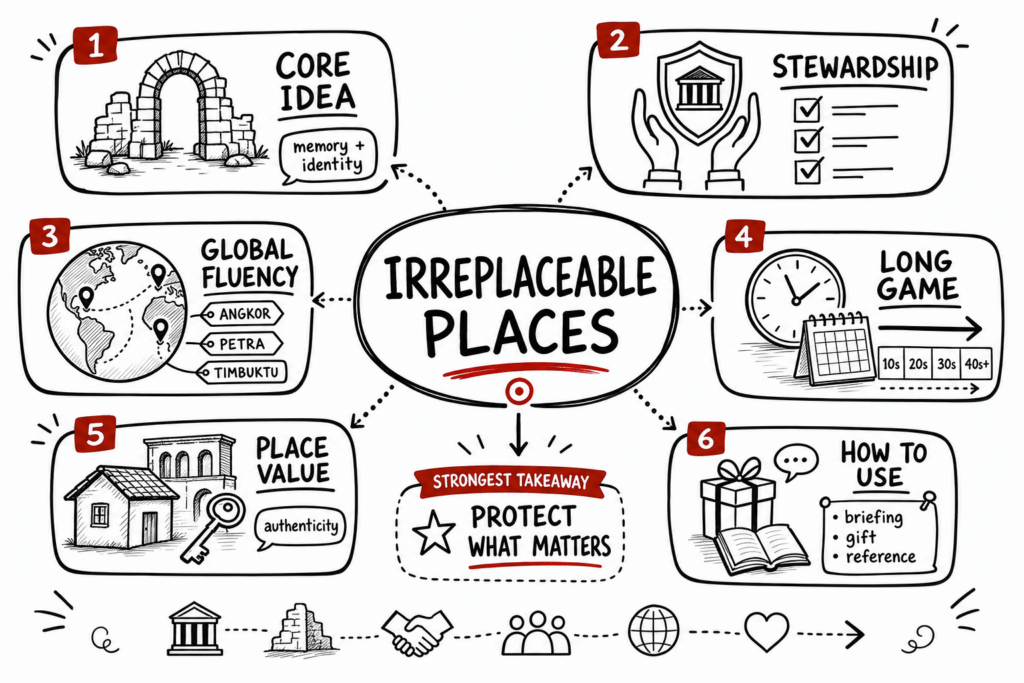
Irreplaceable: 60 of Humanity’s Most Treasured Places is a visual briefing on why certain places carry memory, identity and responsibility that cannot be recreated after loss. The book is most useful when read as an invitation to notice stewardship: what is being protected, who carries the knowledge, and what a place means beyond its appearance. It suits a reader who wants a compact cultural reference with practical questions, rather than a technical conservation manual or a complete history of every site.
Book Overview
The source presents the volume as a World Monuments Fund publication with contributions from Bénédicte de Montlaur, André Aciman, Andrew Solomon and Brinda Somaya. Its 60 sites are approached through images, concise essays and preservation context. The format gives each place enough room to establish a point of connection while keeping the book usable as a visual reference.
The World Monuments Fund provides the relevant institutional context. The UNESCO World Heritage Centre is a useful companion for readers who want a broader public record of heritage sites and their significance. Those resources deepen the subject; they do not turn this short review into a conservation assessment.
Who Should Read It
Read it if you care about place, cultural memory, architecture, travel, philanthropy or the responsibilities that accompany influence. It can work for an executive reading list, a private office, a hospitality library or a thoughtful gift when the goal is cultural curiosity rather than status signaling.
It is less suited to a reader seeking a sustained argument, detailed site histories, engineering guidance or a policy manual. The book’s strength is its range and accessibility. Its limitation is that each place receives only a portion of the depth that a specialist study could provide.
Core Idea
A place is more than its materials. Stone, timber, plaster and earth hold layers of community memory, craft, belief and political history. When a place disappears, a replacement can reproduce a form but not the accumulated relationships that made the original meaningful.
That is the book’s stewardship lens. Preservation is not a refusal to change; it is a decision to understand what must remain legible while change occurs. A reader can carry that question into a property, brand, family enterprise or institution without pretending that every asset has the same cultural weight.
Best Takeaways
1. Prestige is strongest when tied to responsibility
Admiration is easy. Stewardship asks what a person or institution is prepared to protect, fund, document or leave alone. The book makes cultural fluency more useful when it leads to respectful attention instead of collecting impressive references.
2. Place is a strategic asset
For real estate, hospitality and city-building, location includes narrative depth and community meaning. Before changing a place-based asset, ask which history is visible, which stakeholders hold knowledge, what can be adapted, and what would be difficult to restore if removed. Those questions improve judgment without promising a particular financial or reputational result.
3. The best global fluency is specific
Specific names, places and preservation questions are more useful than vague claims of worldliness. The book gives a reader a starting vocabulary for asking better questions about a destination, a neighborhood or a cultural institution.
4. Conservation is an operating model
Durable preservation depends on funding, governance, expertise, local participation and patience. Those ingredients may remind a leader of a durable organization, but the comparison is a prompt for reflection rather than a claim that cultural work can be managed like a company.
Where It Falls Short
Sixty sites cannot receive the detail of a dedicated monograph. Readers may want more maps, timelines, local voices and explanation of how specific conservation choices were made. The polished visual format also leaves less room for the conflicts that surround ownership, tourism, climate risk, development and displacement.
Those limits are part of the reading decision. Treat the volume as a carefully selected doorway into a large subject. Follow a site that interests you with institutional, local and specialist sources before making a travel, investment, donation or development decision.
How to Apply It
Use it as a 20-minute cultural briefing
Choose three sites and ask four questions: what is being protected, who carries responsibility, what threatens continuity, and what would be lost if the place disappeared? Keep the discussion open to local context rather than treating a quick briefing as expertise.
Translate preservation into leadership discipline
Identify one thing in your own work that cannot be rebuilt quickly: trust, craft knowledge, a relationship, a founder’s standard or a place’s character. Then ask what ordinary operating choice protects it. The exercise is useful because it connects long-horizon care to a decision a team can actually name.
Gift it with intention
Pair the book with a note about stewardship, place or curiosity when that connection is real. A relevant gift is more thoughtful than a generic luxury signal, and the recipient can decide how deeply to pursue the subject.
Pair it with deeper reading
Use the book as a front door to heritage registers, local histories, adaptive-reuse studies, conservation research and community perspectives. Different sources answer different questions; no single visual volume can stand in for all of them.
Final Verdict
Irreplaceable is a strong choice for a reader who wants cultural context in a concise, visually led form. It is accessible, giftable and substantial enough to start a conversation about memory, place and responsibility. Its lasting value is the question it leaves behind: what matters here, and what would be impossible to recreate?
You can request a complimentary one-hour conversation with a senior advisor who is an experienced operator. Talk through your next move