What is The 5 Types of Wealth summary for leaders?
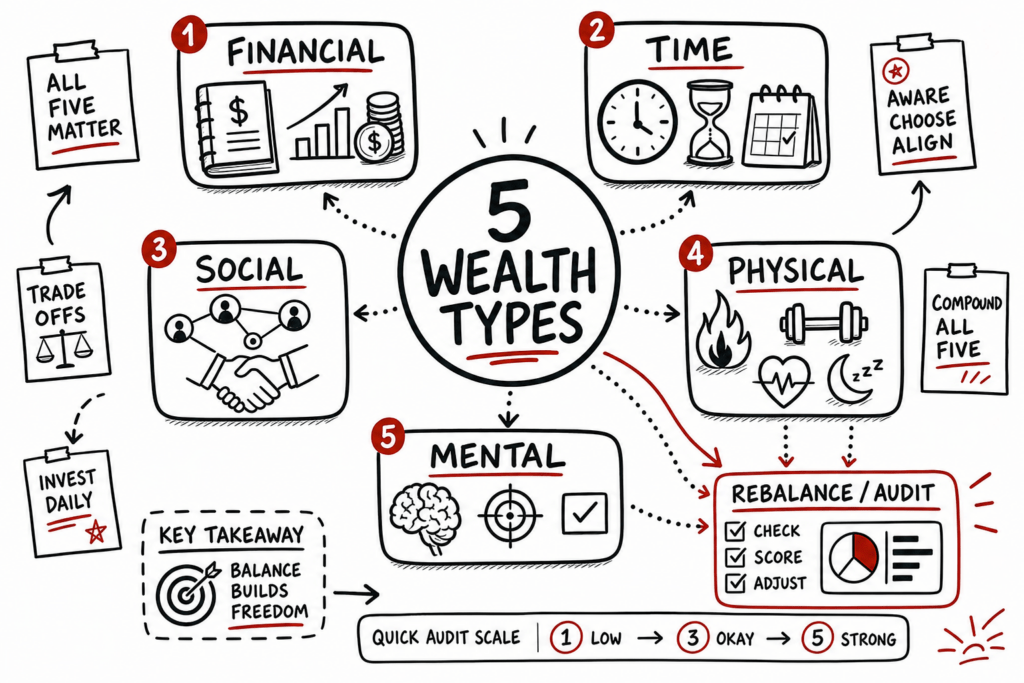
The 5 Types of Wealth summary for ambitious professionals and luxury real estate leaders is this: Sahil Bloom argues that durable success requires managing five forms of wealth—financial, time, social, physical, and mental—not maximizing income while quietly bankrupting the rest. The strategic implication is a leadership audit: if your calendar, energy, relationships, or clarity are deteriorating while revenue rises, your “net worth” is overstated. A practical KPI is a weekly wealth allocation review: track at least one leading indicator in each category, such as uninterrupted strategic hours, sleep average, meaningful relationship touches, exercise sessions, and focused decision time. The book fits readers who want a holistic success framework, not another hustle manual. For luxury real estate operators, the value is less about novelty and more about permission to rebalance before performance declines, client judgment gets reactive, or a high-earning business becomes personally expensive.
Who Should Read It
The 5 Types of Wealth by Sahil Bloom is written for people who have achieved enough to know that achievement alone does not solve the deeper allocation problem. That makes it especially relevant for luxury real estate leaders, founders, rainmakers, and senior operators who live inside high-stakes calendars, emotionally loaded negotiations, and client expectations that rarely respect office hours.
This is not a technical finance book. It is a personal development book summary candidate for professionals who already understand ambition but need a cleaner operating system for success. If your business is growing but your body is running on borrowed energy, your relationships are getting leftovers, or your calendar has become a public utility, this book will probably land.
The ideal reader is not looking for permission to slow down into mediocrity. They are looking for a more intelligent way to sustain performance. That distinction matters. In luxury real estate, reputation compounds over years, but burnout can damage judgment in a single season. A strong The 5 Types of Wealth review should recognize that Bloom is not arguing against financial ambition. He is arguing against letting one form of wealth consume the rest.
Core Idea
The core idea is simple: wealth is multidimensional. Bloom organizes it into five categories: financial wealth, time wealth, social wealth, physical wealth, and mental wealth. The book’s strength is not that these categories are shocking. They are not. Its strength is that the framework makes the trade-offs visible.
Traditional success metrics are clean because they are easy to count. Revenue, net worth, units sold, gross commission income, team size, average price point, database growth. These matter. But they are incomplete. A principal can be financially richer while becoming time-poor, physically fragile, relationally thin, and mentally scattered. That is not sustainable leadership. It is deferred cost.
For a luxury real estate leadership book angle, the framework works because the industry rewards urgent responsiveness. A top advisor can confuse accessibility with value, over-service with excellence, and adrenaline with momentum. Bloom’s model pushes a harder question: what kind of wealth are you converting into financial gain, and is the exchange still worth it?
Readers familiar with Bloom’s essays or his newsletter will recognize his style: clear frameworks, short reflections, and practical prompts. The book is designed to be usable, not ornamental. It gives language to a problem many high performers privately feel but rarely quantify.
Best Takeaways
1. Wealth rebalancing is a leadership discipline
The strongest The 5 Types of Wealth key takeaways start with rebalancing. Leaders already rebalance financial portfolios. The book asks why they rarely rebalance time, energy, relationships, and attention with the same seriousness. For a team leader or brokerage principal, this is not soft. Your capacity affects recruiting, negotiation quality, client trust, and decision speed.
A practical version: review your week the same way you would review a P&L. Where did your highest-value hours go? Which meetings created leverage? Which obligations were status theater? Which relationships received meaningful attention? Which choices protected or degraded your health?
2. Time wealth is often the first hidden crisis
Many successful professionals do not feel poor financially. They feel poor in control. Time wealth is the ability to direct meaningful portions of your life rather than constantly reacting to other people’s priorities. In luxury real estate, this can be the difference between being a trusted advisor and being permanently on call.
The leadership lesson is not to become unavailable. It is to design availability. Client-facing excellence does not require calendar chaos. It requires clear standards, trained support, communication rhythms, and boundaries that protect strategic thinking.
3. Social wealth is a competitive advantage, not a side benefit
Bloom’s model treats relationships as a form of wealth. For real estate leaders, that should be obvious, but it is often misunderstood. Social wealth is not the number of contacts in a CRM. It is the depth, trust, and mutual goodwill in the relationships that matter.
A business application: segment your relationship strategy beyond lead temperature. Track high-trust referral partners, past clients who deserve personal attention, team members who need development, and family relationships that should not be sacrificed to market cycles. If your business depends on trust, relationship neglect is not a personal issue. It is a strategic risk.
4. Physical and mental wealth shape judgment
This may be the most under-discussed part of The 5 Types of Wealth leadership lessons. Exhausted leaders make narrower decisions. They become reactive, impatient, and vulnerable to short-term thinking. In high-end real estate, where one conversation can affect a multimillion-dollar outcome, your nervous system is part of your business infrastructure.
Sleep, movement, recovery, and mental clarity are not lifestyle accessories. They are decision-quality inputs. If your role requires reading people, negotiating under pressure, and staying calm when clients are emotional, physical and mental wealth directly affect revenue protection.
Where It Falls Short
This The 5 Types of Wealth book review would be too generous if it ignored the limits. The framework is useful, but it is not radically new. Readers deep into performance psychology, executive coaching, or holistic leadership may recognize familiar territory: balance, intentionality, health, relationships, purpose, and time ownership.
The risk is that some readers will consume the model as inspiration rather than governance. A framework can make you feel clear without forcing behavior change. The book is most valuable when translated into calendar decisions, delegation decisions, client boundaries, and measurable routines. Without that, it becomes another well-packaged reminder that life is bigger than work.
Another caveat: high-performing professionals may resist parts of the message because financial wealth is still the scoreboard most visible to the market. In luxury real estate, production rankings, listing volume, and public reputation create strong incentives to keep pushing. Bloom’s argument requires maturity: the confidence to measure success with private metrics even when the industry celebrates public ones.
That said, the book is not anti-ambition. The better critique is that ambitious readers must do the hard work of operationalizing it. The idea is clean. The implementation is where the value is either captured or lost.
How to Apply It
Run a five-wealth audit
Start with a simple score from 1 to 10 in each category: financial, time, social, physical, and mental wealth. Do not overthink it. The goal is not precision; it is pattern recognition. Then ask: which score is most likely to damage my leadership over the next 12 months if ignored?
For example, a luxury agent may score high on financial wealth but low on time and physical wealth. A brokerage owner may have strong social wealth externally but weak family presence internally. A team leader may be financially stable but mentally overloaded from being the decision bottleneck.
Create one KPI per wealth type
Keep it measurable. Financial wealth might be monthly profit margin or savings rate. Time wealth might be five protected strategic hours per week. Social wealth might be three meaningful non-transactional relationship touches. Physical wealth might be four workouts or a seven-hour sleep average. Mental wealth might be two uninterrupted thinking blocks or a daily shutdown ritual.
The point is not to turn your life into a spreadsheet. The point is to stop managing only what your business reports already track.
Use the framework before major commitments
Before accepting a new listing, launching a new market, hiring a key role, joining a board, or expanding a team, ask what the decision costs across all five forms of wealth. A deal can be profitable and still be expensive. A client can be prestigious and still be corrosive. Growth can be correct and still require a support structure before you say yes.
Teach it to your team without making it precious
For leaders, the framework becomes more powerful when it informs culture. You do not need a dramatic offsite. Try a monthly leadership conversation: what is helping performance, what is draining capacity, and where are we over-indexing on short-term output at the expense of long-term excellence?
This is wealth rebalancing for leaders in its most practical form. It protects the asset behind the business: the people making high-quality decisions under pressure.
The 5 Types of Wealth Summary: Final Verdict
Sahil Bloom The 5 Types of Wealth is a useful read for professionals who have outgrown one-dimensional success. It will not give luxury real estate leaders a magic operating system, and it should not be treated as a substitute for strategy, financial discipline, or hard execution. But it does provide a clear lens for spotting the hidden costs of achievement before they become expensive.
The best reader fit is the ambitious operator who wants a sharper definition of wealth without abandoning high standards. If you are building a serious business, leading a team, managing affluent clients, or trying to sustain excellence without quietly depleting your life, this framework deserves a place on your reading list.
For more private-briefing style reviews and leadership strategy for high-performance real estate professionals, read more RE Luxe Leaders strategy briefings—or book a confidential strategy call when you are ready to recalibrate the business behind the brand.